
Key Takeaway: RISC-V microcontrollers are transforming embedded systems in 2026 by offering an open-source, royalty-free instruction set architecture that enables customization, reduces costs, and breaks the dominance of proprietary ARM and x86 ecosystems. With major chipmakers launching RISC-V based MCUs and the ecosystem reaching critical mass, embedded developers now have a compelling third option that combines flexibility with growing software and toolchain support.
Table of Contents
1. Why RISC-V Matters in 2026
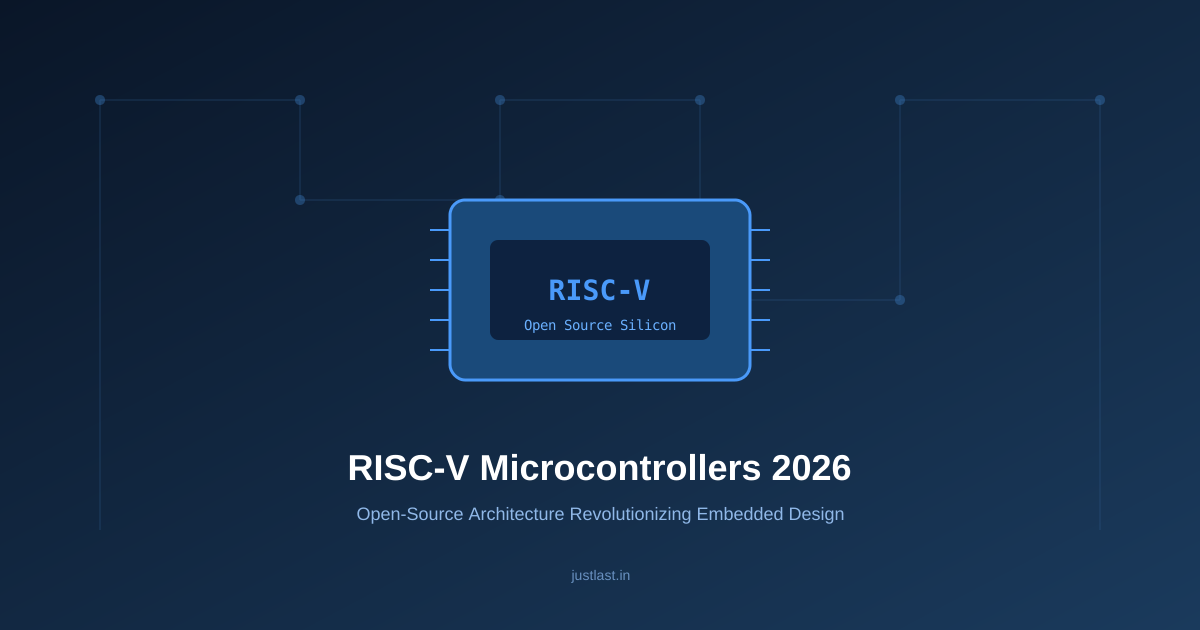
The embedded systems world has long been dominated by ARM Cortex-M series microcontrollers and a handful of proprietary architectures. RISC-V, an open standard instruction set architecture (ISA) developed at UC Berkeley in 2010, has matured significantly over the past few years and is now a serious contender in the microcontroller space.
In 2026, several factors have converged to make RISC-V microcontrollers a practical choice for production embedded designs. The open-source nature of the ISA means no licensing fees, which reduces per-unit costs especially for high-volume applications. More importantly, it allows companies to customize the processor core, adding specialized instructions for their specific workloads such as AI inference at the edge, motor control algorithms, or sensor fusion pipelines.
The RISC-V International organization reports that over 10 billion RISC-V cores have shipped as of mid-2026, with microcontroller-class cores representing the fastest-growing segment. Silicon vendors including Espressif, StarFive, Bouffalo Lab, and Western Digital have all launched RISC-V based MCUs that compete directly with established ARM offerings on both price and performance.
2. The RISC-V Microcontroller Ecosystem
The RISC-V MCU ecosystem has expanded dramatically. Here are the key players and their offerings in 2026:
Espressif ESP32-C6 and ESP32-P4: Espressif has been a pioneer in bringing RISC-V to the masses. The ESP32-C6 features a single-core 160MHz RISC-V processor with Wi-Fi 6 and Bluetooth 5.3, while the newer ESP32-P4 packs a dual-core 400MHz RISC-V processor with a hardware vector extension for AI workloads. Both are priced competitively against ARM-based alternatives.
StarFive JH7110: This is a RISC-V application processor that runs Linux, making it suitable for more complex embedded systems. With a quad-core 64-bit RISC-V CPU and integrated GPU, it competes with ARM Cortex-A series chips in single-board computers and industrial controllers.
Bouffalo Lab BL70x Series: These ultra-low-power RISC-V MCUs target IoT applications with integrated Bluetooth LE, Zigbee, and Thread radios. Power consumption figures rival the best ARM Cortex-M4 designs while offering more flexibility in peripheral configuration.
Andes Technology and Synopsys: These companies provide RISC-V IP cores that silicon vendors can integrate into custom SoCs. The availability of production-grade RISC-V IP has lowered the barrier for companies wanting to build application-specific microcontrollers.
3. RISC-V vs ARM vs x86 for Embedded Applications
Choosing between RISC-V, ARM, and x86 depends heavily on your application requirements. Here is a practical comparison:
Cost: RISC-V has a clear advantage with zero licensing fees. ARM Cortex-M processors require upfront license fees plus royalty payments per chip, which can add $0.10-$0.50 per unit. For high-volume production, RISC-V can yield significant savings.
Performance: In raw benchmarks, RISC-V cores at equivalent clock speeds and process nodes perform similarly to ARM Cortex-M4 and M7 class processors. The gap narrows further when custom instructions are added. For most embedded applications — sensor readout, motor control, communication protocols — both architectures offer adequate performance.
Power Efficiency: ARM still holds a slight edge in ultra-low-power sleep modes, but RISC-V implementations from Bouffalo Lab and others are closing the gap. For battery-powered IoT sensors that spend most of their time sleeping, both architectures now offer sub-microamp standby currents.
Software and Toolchain: ARM has decades of mature toolchain support. RISC-V has made significant strides with GCC and LLVM support, Zephyr RTOS, FreeRTOS, and even some Linux distributions. However, proprietary IDE support and debug tooling remain less polished for RISC-V.
4. Development Tools and Workflow
Developing for RISC-V microcontrollers in 2026 is increasingly similar to developing for ARM. Here is the typical workflow:
PlatformIO and VS Code: PlatformIO now has first-class RISC-V support. Developers can target boards like the ESP32-C6 or SiFive HiFive using the same familiar PlatformIO interface used for ARM boards. Build configurations, library management, and debugging all work through the same unified interface.
Zephyr RTOS: Zephyr has excellent RISC-V support and is the recommended RTOS for complex RISC-V embedded projects. It supports multiple RISC-V platforms, provides a rich set of device drivers, and has a well-organized build system.
Arduino Ecosystem: The Arduino IDE and ecosystem support several RISC-V boards. The Arduino Nano ESP32 (based on the ESP32-C6) brought RISC-V to millions of hobbyists. This has significantly expanded the community and available libraries.
Debug and Trace: OpenOCD supports RISC-V via JTAG, and affordable debug probes like the SiFive FE310 or generic FTDI-based JTAG adapters work well. Segger J-Link added RISC-V support in 2025, bringing production-grade debugging capabilities.
5. Real-World Applications and Case Studies
RISC-V microcontrollers are finding their way into diverse applications. Here are some notable deployment scenarios:
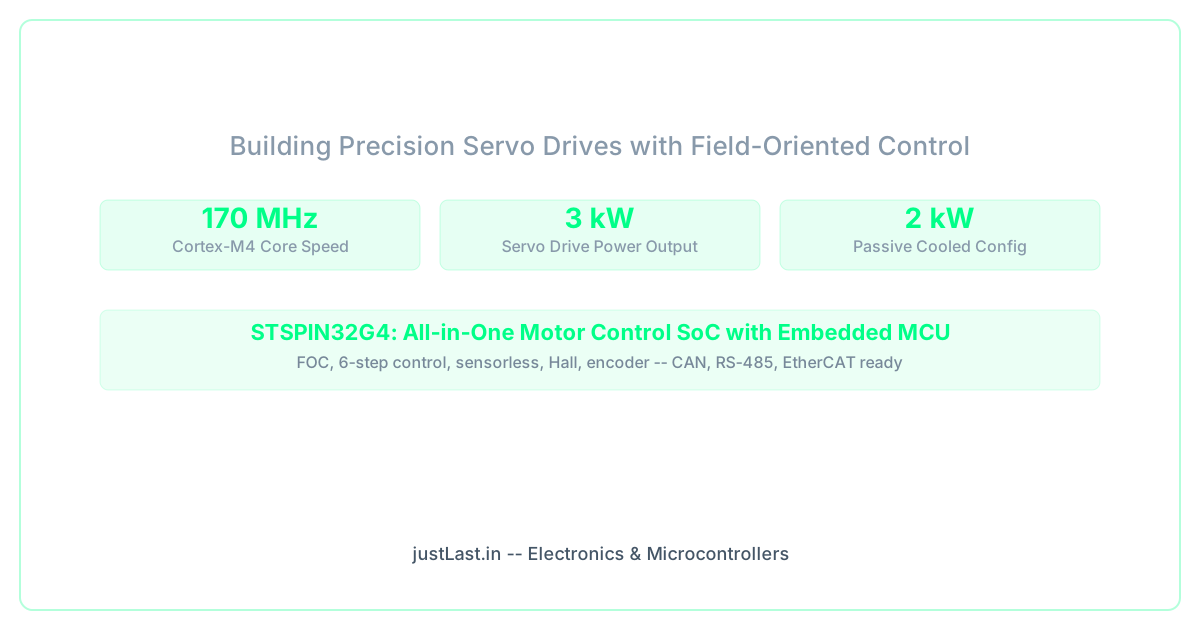
Industrial Motor Control: A European manufacturer recently migrated their servo motor controller from an ARM Cortex-M4 to a custom RISC-V core with hardware acceleration for field-oriented control (FOC). The result was a 40% reduction in control loop latency and a 25% reduction in BOM cost. The custom instructions for trigonometric calculations eliminated the need for a separate math coprocessor.
Smart Sensors: Environmental monitoring sensors using RISC-V based MCUs with integrated AI accelerators enable on-device pattern recognition without sending data to the cloud. A building management system deployment uses ESP32-C6 based sensors to detect occupancy patterns and optimize HVAC energy usage, achieving 30% power savings compared to cloud-dependent systems.
Consumer IoT: Smart home devices increasingly use RISC-V for cost-sensitive applications. A major smart plug manufacturer switched from an ARM Cortex-M0 to a domestic RISC-V MCU, reducing per-unit cost by $0.35 across 10 million units annually, while maintaining equivalent performance and power consumption.
6. Challenges and Limitations
Despite the rapid progress, RISC-V microcontrollers face several challenges that embedded engineers should consider:
Fragmentation: Unlike ARM which has a unified ecosystem with standardized CMSIS and peripheral APIs, RISC-V implementations vary significantly between vendors. Code written for one RISC-V MCU may require substantial modification to run on another. The RISC-V standard defines the ISA, but not peripherals, memory maps, or boot sequences.
Mature Peripherals: ARM MCUs offer a vast array of well-tested peripheral IP (USB, Ethernet, CAN-FD, display controllers). RISC-V SOCs are catching up but still lack the breadth and maturity of peripheral options available for ARM.
Security Features: ARM TrustZone provides hardware-isolated trusted execution environments. RISC-Vs equivalent, the Physical Memory Protection (PMP) and WorldGuard extensions, are newer and less widely implemented. For applications requiring certified security, ARM still has the edge.
Supply Chain: RISC-V chips are available from many vendors, but shortages affected certain RISC-V MCU lines in late 2025. The supply chain is stabilizing but has not yet reached the robustness of the ARM ecosystem.
7. Future Outlook and Roadmap
The RISC-V roadmap for microcontrollers looks promising. By late 2026 and into 2027, we expect:
RISC-V Cortex-M7 Competitors: Higher-performance RISC-V cores matching ARM Cortex-M7 class performance will enter mass production. These will feature single-cycle multiply-accumulate, hardware floating point, and caches comparable to the best ARM offerings.
Standardized Peripheral Interface: The RISC-V International consortium is working on a standard platform specification that would reduce fragmentation. The RISC-V Platform Management Interface (RPMI) aims to provide consistent boot, power management, and peripheral access across implementations.
Functional Safety Certification: Work is underway to certify RISC-V cores for ISO 26262 (automotive) and IEC 61508 (industrial safety) applications. Several vendors expect certification by late 2027, opening up automotive and safety-critical industrial markets.
AI at the Edge: The RISC-V vector extension (RVV 1.0) enables efficient AI inference on microcontrollers. Chips leveraging this extension can run small neural networks for keyword spotting, anomaly detection, and sensor fusion without cloud connectivity.
Frequently Asked Questions
Can I migrate existing ARM-based projects to RISC-V?
Migration requires rewriting low-level code including startup files, linker scripts, and peripheral drivers. Application logic in C/C++ typically ports with minimal changes if you use abstraction layers like Zephyr or Arduino. For simple projects, migration can take 2-4 weeks; for complex industrial controllers, expect 2-4 months.
Is RISC-V truly free and open source?
The base RISC-V ISA is free and open under permissive licenses. However, specific processor implementations (like those from SiFive, Andes, or Synopsys) may be proprietary or require licensing. The freedom lies in the instruction set architecture, not necessarily in every chip implementation.
Which RISC-V MCU is best for beginners?
The ESP32-C6 is the best starting point. It is affordable ($3-5), widely available, has excellent Arduino and ESP-IDF support, and leverages the extensive ESP32 community resources. The SiFive HiFive1 Rev B is another good option for learning bare-metal RISC-V development.
How does RISC-V affect power consumption?
RISC-V MCUs from leading vendors achieve comparable power consumption to ARM Cortex-M series. Typical active mode consumption ranges from 20-200 µA/MHz, with sleep modes below 1 µA. Choose your vendor carefully as power optimization varies significantly between implementations.
What about real-time performance?
RISC-V cores with the machine-level timer and interrupt controller can achieve deterministic real-time performance. The standard PLIC (Platform-Level Interrupt Controller) supports up to 1024 interrupt sources with configurable priority, comparable to ARM NVIC capabilities.
Are RISC-V MCUs suitable for safety-critical applications?
Currently limited, but rapidly improving. Some vendors offer RISC-V cores designed for ISO 26262 ASIL-B compliance, with ASIL-D certification expected by late 2027. For non-safety applications, RISC-V reliability is proven across millions of deployed units.
Related Reading
- STM32 in Industrial IoT: Building Precision Sensor Data Acquisition Systems for Factory Automation in 2026
- Edge Computing in Manufacturing 2026: Architecture, Benefits, and Real-World Deployments
Sources
- RISC-V International Official Website
- Espressif ESP32-C6 Product Page
- SiFive RISC-V Core IP Overview
- StarFive JH7110 Product Page
- Electronic Design: RISC-V vs ARM vs x86 Overview