Key Takeaway: An EV charged at home costs just ₹0.88–1.5 per km versus ₹6.6 per km for petrol, saving roughly ₹1.5–2 lakh over 5 years at 15,000 km/year — but only if you drive enough and charge at home. At under ~10,000 km/year, petrol often wins on total cost; diesel remains the middle ground for high-mileage highway drivers.
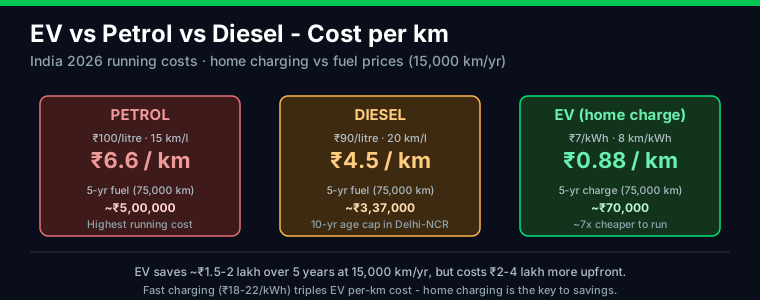
Table of Contents
1. Overview
The “which is cheaper” question in Indian car buying is usually reduced to the sticker price. But the honest answer lives in the total cost of ownership (TCO) — everything you spend over the life of the car: purchase price, fuel or charging, maintenance, insurance, and what you get back at resale. This guide compares EV vs petrol vs diesel in India using 2026 prices and real-world efficiency figures, not optimistic ARAI claims, so you can see exactly where each powertrain wins.
2. Running Cost per Kilometre
Running cost is the number every showroom salesperson quotes, and it is where the EV vs petrol vs diesel gap is most visible. Using Delhi-style prices (petrol ~₹100/litre, diesel ~₹90/litre, home electricity ~₹7/kWh) and realistic efficiency, here is what you actually pay per kilometre in 2026:
| Powertrain | Energy price | Efficiency | Cost per km |
|---|---|---|---|
| Petrol | ₹100/litre | 15 km/l | ~₹6.60 |
| Diesel | ₹90/litre | 20 km/l | ~₹4.50 |
| EV (home charge) | ₹7/kWh | 8 km/kWh | ~₹0.88 |
| EV (public DC fast charge) | ₹18–22/kWh | 8 km/kWh | ~₹2.50–3.70 |
Over 75,000 km in five years, that adds up to roughly ₹5 lakh in petrol, ₹3.3–3.5 lakh in diesel, and just ₹70,000–75,000 for an EV charged at home. The caveat that matters: if you rely heavily on public fast chargers at ₹18–22/kWh, your EV per-km cost can triple. Home charging is the single biggest factor in EV savings.
3. 5-Year Total Cost of Ownership
Running cost alone is misleading because EVs cost ₹2–6 lakh more upfront than equivalent petrol or diesel models. A proper TCO comparison on a 15–16 lakh segment car (like the Tata Nexon, which comes in petrol, diesel, and EV versions) at 12,000 km/year shows:
| Cost element (5 years) | Petrol | Diesel | EV |
|---|---|---|---|
| Purchase price (approx.) | ₹11–12 lakh | ₹12–13 lakh | ₹16–18 lakh |
| Fuel/charging cost | ~₹4–5 lakh | ~₹3 lakh | ~₹1–1.4 lakh |
| Maintenance | ~₹70,000–90,000 | ~₹85,000 | ~₹30,000 |
| Insurance (higher for EV) | ~₹1.2 lakh | ~₹1.3 lakh | ~₹1.6 lakh |
| Resale value estimate | −₹5.5–6 lakh | −₹5.5 lakh | −₹7–7.5 lakh |
| Net 5-year cost | ~₹13.5–14.5 lakh | ~₹13–13.5 lakh | ~₹12–14.8 lakh |
At average Indian usage (12,000 km/year), the three powertrains land remarkably close after five years. EVs have the lowest running and maintenance costs but lose ground on the higher purchase price and faster depreciation (roughly 20–25% lower 5-year retention than petrol). Data-driven analyses in 2026 generally show a Nexon EV saving about ₹1.5–2 lakh over its petrol sibling at 15,000 km/year, and up to ₹3.5 lakh with Delhi’s state subsidy included.
Maintenance and reliability
EVs have far fewer moving parts — no engine oil, no timing belt, no clutch, no complex gearbox — so scheduled maintenance is roughly 60–70% lower. Regenerative braking also extends brake pad life. The big EV-specific cost is the battery, but modern packs are warrantied for 8 years / 1.6 lakh km, and most owners keep the car well within that window.
4. Break-Even: When Does an EV Win?
The break-even year in the EV vs petrol vs diesel equation is the point where cumulative EV spending drops below petrol. It depends almost entirely on two numbers: your annual kilometres and your charging mix.
- Under 8,000–10,000 km/year: petrol usually wins. The higher EV purchase price never recovers before resale.
- 10,000–15,000 km/year: diesel is often the financial winner, and petrol is close; EVs break even only in year 6–8.
- 15,000–20,000+ km/year with home charging: the EV pulls ahead at year 3–5 and saves ₹1.5–2 lakh+ over five years.
- Frequent highway driving: diesel’s efficiency advantage shines; EVs lose margin on fast-charging rates.
Also factor in the diesel 10-year age cap in Delhi-NCR, which sharply limits the resale window for diesel cars, and the zero road tax on EVs in many states. If you want the deeper maintenance picture for your EV, read our EV battery health and maintenance guide for Indian climates.
5. Frequently Asked Questions
Which is cheaper to run: EV, petrol, or diesel in India?
On a per-km basis in 2026, an EV charged at home is the cheapest EV vs petrol vs diesel option (~₹0.88–1.5/km), followed by diesel (~₹4.5/km) and petrol (~₹6.6/km). On total cost of ownership, the answer depends on your annual mileage — EVs win for high-mileage home-charging owners.
How many years does an EV take to break even against petrol?
At 15,000+ km/year with home charging, typically 3–5 years. At average 12,000 km/year, around 6–8 years. Under 8,000–10,000 km/year, an EV may never break even before resale.
Is diesel cheaper than petrol in India 2026?
Diesel costs less per litre and delivers better mileage, so its running cost (~₹4.5/km) is about 30% lower than petrol (~₹6.6/km). But diesel cars cost ₹1–1.5 lakh more upfront, and the Delhi-NCR 10-year age cap is a real resale risk.
Does fast charging make EVs expensive?
Public DC fast charging at ₹18–22/kWh raises EV running cost to ₹2.50–3.70/km — still below petrol but far above home charging. Owners without home charging lose much of the EV financial advantage.
Which is the best EV to buy under the Tata Nexon budget?
The Tata Nexon EV, Tata Punch EV, and MG ZS EV are the most popular choices in this segment. The Punch EV is the value pick and the Nexon EV balances range and price. Compare total costs including state EV subsidies before deciding.
Related Reading
- EV Battery Health and Maintenance Guide 2026
- Haryana EV Charging Station Subsidy 2026
- Rooftop Solar Panel Installation in India 2026
Sources
- Times of India — Real Cost of Owning a Car: Petrol vs Diesel vs EV
- EV Community — EV vs Petrol Car India 2026
- Spinny — EVs vs Petrol vs Diesel Cost of Ownership
- Caritch — Petrol vs Diesel vs CNG vs EV Running Costs
Disclosure: This post contains affiliate links. As an Amazon Associate I earn from qualifying purchases.