
Key Takeaway: The best cordless drill for most homeowners in 2026 is a 12–18V brushless drill/driver kit from a platform you can grow into — our top pick is the Ryobi ONE+ HP for value, with the Makita XFD14Z as the best budget option and the DeWalt DCD999B for heavier work.
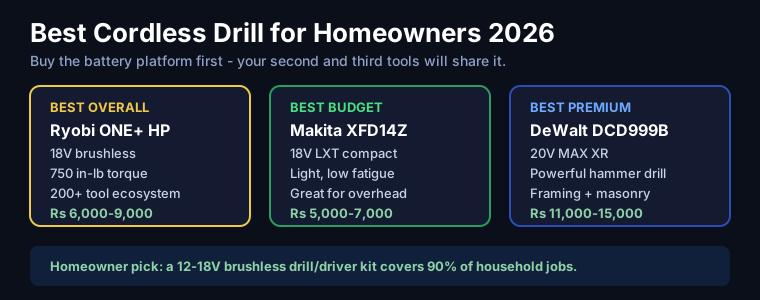
Table of Contents
1. Overview: What a Homeowner Actually Needs
The best cordless drill for a homeowner is not the same drill a framing crew buys. Homeowners drill into drywall, assemble flat-packed furniture, hang shelves, and occasionally drive a few screws. That job profile calls for a light, balanced, brushless drill/driver — not a pro-grade hammer drill with more torque than a truck.
Consumer Reports tested more than 50 cordless drills and found the top performers split into three useful buckets: light-duty (12–20V, small jobs), general-use (12V, most household tasks, half the weight), and heavy-duty (18–20V, decks and large holes). Most homeowners live in the first two buckets. In this buying guide we recommend the drills that actually earned shelf space in a homeowner’s garage.
2. Top Picks: The 3 Best Cordless Drills for Homeowners
???? Best Overall: Ryobi ONE+ HP Brushless Drill (PBLDD01K)
The Ryobi ONE+ HP is the most sensible first drill of 2026. It delivers around 750 in-lb of torque — enough to drive 3-inch structural screws into pressure-treated lumber and bore 3/4-inch Forstner bits — and it sits inside the widest battery ecosystem in the industry (200+ tools, including yard equipment). It is not as refined as pro-tier drills, but for a homeowner the price-to-versatility ratio is unbeatable. Check price on Amazon.
???? Best Budget: Makita XFD14Z 18V LXT
The Makita XFD14Z is the most comfortable drill to use — compact, light, and beautifully balanced. If you do a lot of ceiling, wall, and overhead work (curtain rods, light fixtures, TV mounts), the low weight pays off in the second hour of a job. It has less torque than the DeWalt, but for household tasks it never struggles. Check price on Amazon.
???? Best Premium: DeWalt DCD999B 20V MAX XR Hammer Drill
If your to-do list includes framing, masonry, or lag bolts, the DeWalt DCD999B is the drill that does not quit. It is a true hammer drill with 20V MAX XR power, capable of boring large holes through studs and joists. The catch: it is often sold as a bare tool, so battery and charger are separate. Check price on Amazon.
3. Buying Guide: How to Choose a Cordless Drill
Voltage: 12V vs 18V vs 20V
Voltage dictates the size of the job. 12V tools are lighter and handle most household work. 18V/20V tools are heavier but much more capable for drilling big holes and driving hundreds of screws. For most homeowners, a compact 12V or standard 18V drill is the right balance.
Brushless vs brushed motor
Brushless motors cost more but last longer, run longer per charge, and deliver more power. For a tool you will keep for years, brushless is worth the premium.
Torque and speed
Look for at least 500 in-lb of torque for comfortable household drilling and driving, and two speed ranges (roughly 0–500 rpm for driving, 0–1,500+ rpm for drilling).
Chuck size
A 1/2-inch keyless chuck is standard on 18V drills and accepts almost any bit. A 3/8-inch chuck is fine for lighter 12V tools.
Kit vs bare tool
Kits include batteries and a charger and are almost always the better first purchase. Bare tools only make sense when you already own batteries from the same platform.
4. The Battery Platform Rule
Pick the battery platform, not the drill. Your second and third tools will share that battery — an impact driver, a circular saw, a work light. This is the advice that every serious reviewer repeats, and it is the cheapest way to build a tool collection.
- Ryobi ONE+ — widest ecosystem for homeowners (200+ tools including yard gear).
- DeWalt 20V MAX — strong pro-grade platform with excellent tool availability.
- Makita LXT — one of the most extensive pro ecosystems in the world.
- Bosch 12V/18V — best if you want ultra-compact 12V tools for the house.
Once you are on a platform, stay on it. And if you already own an impact driver, the drill decision is easy: buy the matching brand and model. If you are deciding between a drill and an impact driver, read our cordless drill vs impact driver comparison first.
5. FAQ
Is a 12V cordless drill enough for home use?
For most household jobs — furniture assembly, shelves, drywall anchors, light drilling — yes, a 12V drill is enough and it is much lighter to use. Step up to 18V/20V if you plan to drive large screws or bore big holes regularly.
What is the best cordless drill brand in 2026?
There is no single “best” brand — it is about the battery platform and the model. Ryobi is the best value for homeowners, DeWalt and Makita are the strongest pro choices, and Bosch excels at compact tools.
How much should I spend on a cordless drill?
A good brushless drill/driver kit costs roughly ₹6,000–₹15,000 in India. Avoid the ₹1,500–₹3,000 “deal” drills with brushed motors and tiny batteries — they underpower and wear out quickly.
Do I need a hammer drill for home use?
Only if you drill into concrete, brick, or masonry. For drywall and wood, a standard drill/driver is lighter and better. If you occasionally drill masonry, a drill with a hammer mode (that you can switch off) is the versatile compromise.
Should I buy a drill kit with a battery included?
Yes — for your first drill, always buy a kit with at least one battery and a charger. Buy a second battery so you are never mid-job with a dead tool.
Related Reading
- Cordless Drill vs Impact Driver: Which Do You Actually Need?
- How to Build a Workbench: Complete DIY Guide
- Best Circular Saw in India 2026: Complete Buying Guide
Sources
- Best Cordless Drill for Homeowners 2026 — ToolShed Tested
- The 10 Best Cordless Drills for 2026 — Popular Mechanics
- The Best Drills of 2026 — Wirecutter
- Best Cordless Drills of 2026, Lab-Tested — Consumer Reports
- Best Cordless Drill of 2026 — CNET
Disclosure: This post contains affiliate links. As an Amazon Associate I earn from qualifying purchases.


