
Key Takeaway: Your first cordless battery purchase locks you into an ecosystem for years — DeWALT 20V MAX offers the best value for general workshops, Milwaukee M18 dominates for pros who need the widest tool range, and Makita 18V LXT wins on build quality and low vibration for carpentry and concrete work.
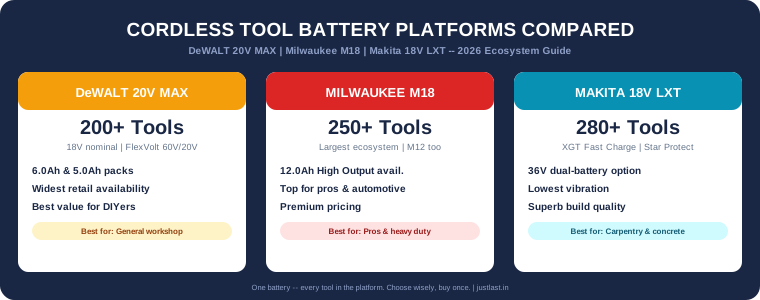
Table of Contents
1. Why Your First Battery Purchase Matters Most
Every cordless tool discussion eventually comes back to the same truth: the battery is the platform. When you buy your first 18V drill, you are not just buying a drill — you are buying into a family of 200 to 300 tools that all share the same battery pack. Switching later means rebuying batteries and chargers, which can easily cost more than the tools themselves. This cordless battery platform comparison will help you make the right call the first time.
In Indian workshops, where a single battery set might power a drill, an angle grinder, a jigsaw, and a blower, the ecosystem decision has real cost consequences. DeWALT, Milwaukee, and Makita dominate the professional market, each with a distinct philosophy about how broad, how deep, and how premium their cordless lineup should be. Understanding those philosophies before you invest saves money and frustration down the road.
The term “20V MAX” from DeWALT confuses many buyers — it is the same nominal voltage as the 18V systems from Milwaukee and Makita. All three use five lithium-ion cells in series (nominal 18V, maximum 20V when fully charged). DeWALT simply labels the maximum voltage while the others label the nominal voltage. Performance, runtime, and power are comparable at the cell level; differences come from battery capacity, motor design, and electronics.
2. DeWALT 20V MAX — The Workshop Workhorse
DeWALT’s 20V MAX platform is the most widely available cordless system in India and globally, with over 200 tools sharing the same slide-pack battery. The standard battery options range from compact 2.0Ah packs for light drilling to 5.0Ah and 6.0Ah packs for grinders and saws. DeWALT also offers FlexVolt batteries that automatically switch between 60V and 20V depending on the tool, giving you a path to heavier-duty tools without a separate battery system.
The strength of DeWALT lies in availability and value. You can find DeWALT batteries and chargers at almost any industrial supplier, and the pricing sits between budget brands and premium Milwaukee. For a general workshop that needs a drill, impact driver, angle grinder, circular saw, and oscillating tool, DeWALT covers every category at a reasonable price. The tools are robust, parts are easy to source, and the warranty network in India has improved significantly in recent years.
DeWALT’s brushless motors (marked “XR” on most tools) deliver noticeable improvements in runtime and power over the older brushed models. If you are buying in 2026, always choose brushless — the price premium is small and the performance gap is large. The 20V MAX batteries include fuel gauges, overheat protection, and compatibility across the entire range, including outdoor power equipment like blowers and trimmers.
Where DeWALT is weaker is in specialty pro tools. Milwaukee offers more automotive, plumbing, and electrical trade-specific tools that DeWALT does not match. For a general fabrication or woodworking shop, this rarely matters, but for a specialized trade, it is worth checking whether DeWALT makes the niche tool you will eventually need.
3. Milwaukee M18 — The Pro’s Ecosystem
Milwaukee’s M18 system is the largest cordless ecosystem available today, with over 250 tools on the same 18V battery. Milwaukee has pursued a strategy of covering every trade — automotive, electrical, plumbing, and construction — with dedicated cordless solutions that often have no direct competitor. If you need a cordless press tool, a cordless drain cleaner, or a cordless copper tubing cutter, Milwaukee probably makes one.
Battery technology is where Milwaukee pushes hardest. The standard M18 packs come in 2.0Ah to 6.0Ah, but the High Output line goes up to 12.0Ah using larger 21700 cells instead of the standard 18650 cells. These high-capacity packs deliver longer runtime for saws and grinders and higher current for demanding applications. Milwaukee also maintains the M12 (12V) compact line on a separate battery, which is excellent for tight spaces but means managing two battery systems if you adopt both.
The trade-off is price. Milwaukee tools and batteries consistently cost 15 to 30 percent more than equivalent DeWALT tools in the Indian market. Some of that premium reflects genuine engineering — Milwaukee’s electronics, motor control, and build quality are excellent — but part of it is brand positioning. For a production shop where downtime costs money, the premium is justified. For a hobby workshop, it may not be.
Milwaukee’s ONE-KEY system adds Bluetooth-based tool tracking, inventory management, and custom settings for some tools. This matters more on large jobsites than in a small workshop, but it is a forward-looking feature. Milwaukee also leads in cordless nailers, having invested heavily in replacing pneumatic tools with battery alternatives.
4. Makita 18V LXT — Precision & Low Vibration
Makita’s 18V LXT platform has been in continuous production since 2005, making it one of the most mature cordless systems available. With over 280 tools, it actually has the broadest catalogue of the three, though many are variations of similar tools. Makita is particularly strong in woodworking and concrete tools — its routers, planers, and rotary hammers are consistently rated among the best for low vibration and fine control.
The LXT battery range includes 1.5Ah through 6.0Ah packs, all with built-in Star Protection Computer Controls — a chip in both the battery and the tool that communicates to prevent overloading, overheating, and over-discharging. This system has proven reliable over years of field use and is one reason Makita batteries hold their capacity well over time. In 2026, Makita also offers XGT (40V) as a separate higher-voltage line for the most demanding tools, though LXT remains the core 18V ecosystem.
Where Makita stands out is for users who need two batteries to create 36V power. Several Makita tools — including circular saws, rotary hammers, and lawn mowers — accept two 18V LXT batteries simultaneously to deliver 36V performance. This is clever because you do not need to buy separate 36V batteries; your existing 18V packs do double duty. DeWALT’s FlexVolt achieves something similar but requires dedicated FlexVolt packs.
Makita’s fast charging is genuinely fast. The DC18RC charger can charge a 3.0Ah battery in about 22 minutes and a 6.0Ah battery in about 55 minutes, which is competitive with or faster than the other brands. For a busy workshop where batteries cycle quickly between tools, charge time matters as much as capacity. The anti-vibration technology in Makita grinders and sanders also reduces fatigue during long sessions — a practical advantage that is easy to overlook when comparing spec sheets.
5. Head-to-Head Comparison
Choosing between these three platforms comes down to matching your priorities against their strengths. The table below summarizes the key differentiators for a cordless battery platform comparison at a glance.
| Feature | DeWALT 20V MAX | Milwaukee M18 | Makita 18V LXT |
|---|---|---|---|
| Tool count (2026) | 200+ | 250+ | 280+ |
| Max battery (standard cells) | 6.0Ah | 12.0Ah (High Output) | 6.0Ah |
| High-voltage path | FlexVolt 60V/20V | M18 Fuel + MX Fuel | 2x18V = 36V / XGT 40V |
| Charge time (3.0Ah) | ~35 min | ~35 min | ~22 min |
| Retail availability (India) | Excellent | Good (growing) | Excellent |
| Price tier | Mid | Premium | Mid-Premium |
| Best for | General workshop | Pros / automotive | Carpentry / concrete |
No single platform wins on every metric. The right cordless battery platform comparison depends on which tools you plan to buy over the next five years, not just the first drill you pick up today. List the five or six cordless tools you are likely to need, check which brands make all of them, and let that shortlist guide your battery decision.
6. How to Choose the Right Platform for Your Workshop
For a first-time buyer setting up a small workshop — the classic combination of a drill/driver, impact driver, angle grinder, jigsaw, and random orbit sander — all three platforms offer excellent kits. DeWALT often has the best combo kit pricing, especially during seasonal sales. Milwaukee kits cost more but frequently include higher-capacity batteries. Makita kits emphasize ergonomics and come with the fastest chargers.
If you already own corded tools and are transitioning to cordless gradually, start with the tool you use most. For metalwork and fabrication, Milwaukee’s grinders and Sawzalls are hard to beat. For woodwork, Makita’s sanders and routers have the edge. For general use where you want the simplest buying experience and the easiest access to spares, DeWALT is the safe default.
Consider service and warranty in your region. In Delhi and other major Indian cities, all three brands have authorized service centers, but DeWALT and Makita have deeper parts availability for older tools. Milwaukee’s network is expanding but can still require shipping tools for warranty work depending on your state. Check local dealer support before committing, especially if you run a production workshop where downtime is costly.
Finally, resist the temptation to mix platforms to cherry-pick the best individual tool from each brand. The whole point of a cordless battery platform comparison is to avoid that trap. Owning two battery systems doubles your charger clutter and means some batteries sit idle while others cycle constantly. Pick one platform for your 18V tools and, if you need a compact line, add the same brand’s 12V system (Milwaukee M12 or Makita 12V CXT) rather than mixing brands.
7. Battery Care & Longevity Tips
Lithium-ion packs last longest when kept between 20 and 80 percent charge for storage. If you will not use a battery for weeks, charge it to about half before storing it in a cool, dry place. Avoid leaving packs in direct sunlight or in a hot vehicle — heat is the single biggest killer of lithium-ion longevity. All three brands have thermal protection that prevents charging when the pack is too hot, but prevention is better than relying on the cutoff.
Use the correct charger for your packs. While DeWALT FlexVolt chargers work across 20V and 60V, and Makita’s DC18RC handles all LXT capacities, avoid third-party chargers that claim universal compatibility. Cheap chargers often skip the cell-balancing step, which leads to uneven cell wear and early pack failure. Genuine chargers also enforce proper charge termination, reducing the risk of overcharging.
In dusty or humid workshop conditions — common in Indian summers and monsoons — keep battery contacts clean and dry. A quick wipe with a dry cloth before inserting a pack prevents grit from entering the tool’s battery compartment. If you use your tools outdoors or on construction sites, consider battery caps for packs not in use; all three brands sell them, and they prevent terminal corrosion.
Frequently Asked Questions
Is DeWALT 20V MAX actually more powerful than Milwaukee M18 or Makita 18V?
No. Despite the name, DeWALT 20V MAX is nominally 18V — the same as Milwaukee M18 and Makita 18V LXT. All three use five lithium-ion cells in series. Real-world power depends on motor design, gearing, and how much current the battery can deliver, not the label on the pack. Compare torque and runtime data, not voltage marketing.
Can I use adapters to run DeWALT batteries on Milwaukee tools or vice versa?
Third-party battery adapters exist but are not recommended for regular use. They bypass the brand’s electronic protections — overheating safeguards, cell balancing, and current limiting — which can damage packs and void warranties. If you must use adapters for occasional cross-brand use, ensure the adapter includes its own protection circuit and never use it on high-draw tools like grinders or saws.
Which platform has the cheapest replacement batteries?
DeWALT replacement batteries are typically the most affordable and widely discounted, especially the 5.0Ah packs. Makita LXT packs sit in the middle, while Milwaukee M18 — particularly the High Output 12.0Ah — commands the highest prices. Watch for kit deals that include two batteries: buying tools in combo kits is almost always cheaper per-battery than buying packs separately.
Should I wait for newer battery technology before buying in 2026?
No. Tabless and solid-state batteries are in development but will not reach mainstream cordless tools for several years. Current 21700 and 18650 lithium-ion packs will remain the standard through at least 2028, and all three brands have committed to keeping their 18V platforms forward-compatible. Buying now locks you into a proven ecosystem rather than waiting for an uncertain upgrade.
Related Reading
- 10 Essential Power Tools Every Workshop Needs in 2026
- Angle Grinder vs Rotary Tool (Dremel): Which Should You Buy in 2026?
- Power Drill vs Impact Driver 2026: Which One Do You Actually Need?
- Best Table Saws Under $500 in 2026: Complete Buying Guide
Sources
- DeWALT — Cordless Drills and Hammer Drills (Official)
- Milwaukee Tool — M18 System Overview (Official)
- Makita — 18V LXT Cordless Platform (Official)
- Pro Tool Reviews — Cordless Battery Platform Comparison
Disclosure: This post contains affiliate links. If you purchase through these links, we may earn a small commission at no extra cost to you. This helps support our independent testing and reviews.