Key Takeaway: India’s Digital Rupee (eRupee) CBDC has crossed 5 million retail users with 50+ participating banks by mid-2026, featuring offline functionality, programmable money capabilities, and wholesale settlement integration — positioning it as a transformative force in India’s digital payment ecosystem alongside UPI.
📖 Table of Contents
1. Introduction to India’s CBDC Journey
India’s Digital Rupee CBDC journey began with pilot launches in late 2022 and has accelerated dramatically through 2026. The Reserve Bank of India has taken a calibrated approach, starting with wholesale CBDC for government securities settlement before expanding to retail users. As of mid-2026, the eRupee has crossed 5 million retail users with over 50 participating banks across the country.
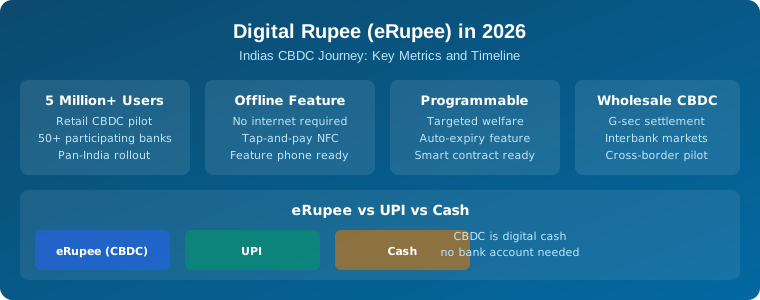
The Central Bank Digital Currency represents a fundamental shift in how money works. Unlike UPI, which is a payment system that transfers money between bank accounts, the Digital Rupee is digital cash — a direct liability of the RBI, just like physical currency. This means it does not require a bank account to hold or use, making it a powerful tool for financial inclusion.
India’s approach to CBDC has been widely recognized as one of the most thoughtful globally. The RBI has prioritized interoperability with existing systems, offline functionality, and privacy protection while maintaining the regulatory safeguards necessary to prevent money laundering and tax evasion.
2. Retail CBDC (eRupee-R) Progress in 2026
The retail Digital Rupee pilot, designated eRupee-R, has expanded from an initial group of 4 banks to over 50 participating banks covering all major public and private sector lenders. The pilot now operates in over 100 cities across India, with both person-to-person (P2P) and person-to-merchant (P2M) transactions supported.
A key milestone in 2026 has been the integration of eRupee wallets into existing mobile banking apps, eliminating the need for a separate CBDC application. Users of SBI, HDFC Bank, ICICI Bank, and other major banks can now access their Digital Rupee wallets through their existing banking apps, significantly lowering the adoption barrier.
The transaction volume has shown steady growth, with daily transactions crossing 500,000 by June 2026. While this is still a fraction of UPI’s billions of monthly transactions, the growth trajectory is impressive for a new payment instrument that is still in the pilot phase.
3. Wholesale CBDC (eRupee-W) for Interbank Markets
The wholesale CBDC (eRupee-W) has been operating since late 2022 for government securities settlement. The Clearing Corporation of India (CCIL) has integrated eRupee-W into its settlement systems, enabling real-time gross settlement of G-sec transactions without the need for interbank liquidity management.
The wholesale CBDC has demonstrated significant efficiency gains in interbank markets. By eliminating the need for prefunding and reducing settlement risk, eRupee-W has reduced transaction settlement times from hours to minutes. The RBI has also piloted cross-border CBDC transactions with other central banks, including the Bank for International Settlements (BIS) innovation hub projects.
4. Offline Functionality and Financial Inclusion
One of the most innovative features of India’s Digital Rupee is its offline functionality. Using near-field communication (NFC) technology, eRupee transactions can be completed without an internet connection — a critical feature for India’s rural areas where internet connectivity remains unreliable.
The offline Digital Rupee works through tap-and-pay NFC between two devices, with transactions settling when connectivity is restored. This feature is being tested in selected rural districts and could be a game-changer for financial inclusion. Additionally, feature phone support is being developed to ensure that the Digital Rupee is accessible to the 400+ million Indians who still use feature phones rather than smartphones.
5. Digital Rupee vs UPI vs Cash
Each payment method has distinct advantages. UPI is fast, free, and deeply integrated into Indian commerce — processing over 13 billion transactions per month. Cash remains universally accepted and entirely private. The Digital Rupee combines elements of both: it is digital like UPI but does not require a bank account, and it is a direct claim on the RBI like cash.
The programmable nature of CBDC is where the Digital Rupee truly differs. The government can program eRupee for specific purposes — for example, fertilizer subsidies that can only be used at agricultural input stores. This reduces leakage in welfare programs while maintaining user privacy within defined parameters.
6. Future Roadmap and Cross-Border Payments
The RBI has outlined a phased roadmap for the Digital Rupee through 2027-28. Key milestones include full nationwide rollout (expected in 2027), cross-border remittance corridors with the UAE and Singapore, corporate treasury applications for programmable payments, and integration with the Account Aggregator framework for credit underwriting.
Cross-border CBDC interoperability is a major focus area. India is working with the Bank for International Settlements and other central banks on the mBridge project, which enables multi-CBDC cross-border payments. If successful, this could reduce the cost of international remittances — a significant benefit for India, which received over $100 billion in remittances in 2025.
Frequently Asked Questions
Is the Digital Rupee the same as UPI?
No. UPI is a payment system that moves money between bank accounts. The Digital Rupee is digital cash — a direct liability of the RBI that does not require a bank account.
Can I earn interest on Digital Rupee holdings?
Currently, retail CBDC does not earn interest, similar to physical cash. The RBI has indicated that interest-bearing CBDC could be considered in the future for wholesale applications.
Is the Digital Rupee taxable?
Transactions in Digital Rupee are treated the same as cash or UPI transactions for tax purposes. No additional taxes apply specifically to CBDC usage.
How does offline Digital Rupee work?
Offline transactions use NFC tap-and-pay technology between two devices. Transactions are recorded locally and settled when the devices reconnect to the internet.
Related Reading
- UPI MDR Revival in 2026: What the Proposed Merchant Fee Means
- RuPay Credit Card on UPI in 2026: Complete Guide
- CIBIL Score Rules 2026
Sources
- RBI — Central Bank Digital Currency FAQs
- BIS — CBDC: Opportunities and Challenges
- RBI Press Release — Digital Rupee Pilot Expansion