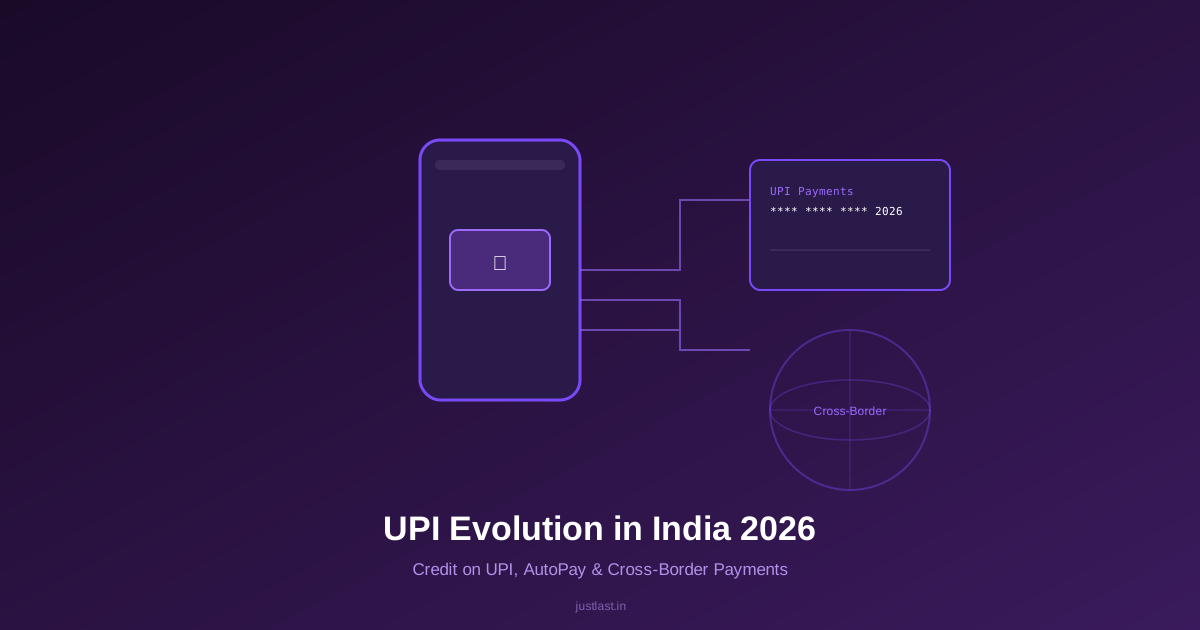
Key Takeaway: The Unified Payments Interface (UPI) in India has undergone transformative changes in 2026, with Credit on UPI enabling millions of new users to access pre-sanctioned credit lines through their UPI apps, enhanced AutoPay 2.0 supporting recurring payments with dynamic amounts, and cross-border UPI expansion reaching 15+ countries. Transaction volumes have crossed 18 billion monthly, cementing UPI as the world’s most adopted real-time payment system.
Table of Contents
- 1. UPI Growth Trajectory in 2026
- 2. Credit on UPI: Revolutionizing Access to Credit
- 3. AutoPay 2.0: Smarter Recurring Payments
- 4. Cross-Border UPI Expansion
- 5. RuPay Credit Card and UPI Integration
- 6. Security and Fraud Prevention
- 7. Economic Impact and Financial Inclusion
- 8. Frequently Asked Questions
1. UPI Growth Trajectory in 2026
The growth of UPI in 2026 has been nothing short of remarkable. With over 18 billion monthly transactions valued at more than ₹30 lakh crore, UPI processes more real-time payments than any other system globally. This represents a 40% year-over-year increase in transaction volume, driven by both new use cases and deeper penetration in Tier-2 and Tier-3 cities.
The National Payments Corporation of India (NPCI) reports that UPI now has over 450 million unique monthly active users and 70 million merchant acceptance points across the country. The average transaction value has stabilized at around ₹1,650, indicating that UPI is now used for a wide range of payments from small street vendor purchases to large retail transactions and utility bill payments.
Several structural factors are driving this continued growth. Smartphone penetration in rural India crossed 55% in early 2026, bringing millions of new users into the digital payments ecosystem. The government’s continued push for digital transactions through tax incentives and the rapid expansion of QR code-based acceptance in small towns have both contributed to sustained growth.
Data from the Reserve Bank of India shows that UPI has overtaken debit cards as the preferred payment instrument for online transactions, with credit cards maintaining their position for large-ticket and EMI purchases — a position now challenged by the Credit on UPI feature.
2. Credit on UPI: Revolutionizing Access to Credit
The most transformative UPI feature in 2026 is Credit on UPI. This facility allows banks and fintech lenders to extend pre-sanctioned credit lines to users through their UPI-enabled apps. Users can make UPI payments using this credit line, with flexible repayment options ranging from pay-in-3 (interest-free for 3 months) to longer EMI tenures.
Credit on UPI works seamlessly within the existing UPI flow. When a user initiates a payment, their UPI app presents payment options including savings account, credit line, and linked RuPay credit card. If they select the credit line, the transaction is settled immediately to the merchant, and the user repays the lender according to the agreed terms.
By mid-2026, over 40 million credit lines have been activated under this program, with an average credit limit of ₹25,000 per user. Notably, 60% of these credit lines have been extended to first-time credit users who previously had no access to formal credit products. This has significant implications for financial inclusion in India, where a large portion of the population lacks credit scores and bank-issued credit cards.
Major lenders participating in Credit on UPI include State Bank of India, HDFC Bank, ICICI Bank, and several fintech lenders including slice, KreditBee, and MobiKwik. The default rates have been encouragingly low at 2.3%, partly due to the behavioral data that UPI provides lenders for credit assessment.
3. AutoPay 2.0: Smarter Recurring Payments
AutoPay on UPI has been upgraded significantly with AutoPay 2.0, addressing many of the limitations of the original recurring payments mandate. The key enhancements include:
Dynamic Amounts: The original AutoPay was limited to fixed-amount recurring payments. AutoPay 2.0 supports variable amounts within a predefined range. This is particularly useful for utility bills that fluctuate monthly, subscription services that may change pricing, and insurance premiums that vary by age or coverage.
Multiple Frequencies: Beyond monthly and yearly, AutoPay 2.0 supports weekly, fortnightly, and custom intervals. This enables new use cases like daily savings plans, weekly EMI collections, and fortnightly rent payments.
Standing Instruction with Mandate Block: Unlike the earlier version where each transaction required individual approval, AutoPay 2.0 supports mandate-block functionality where the user approves a maximum amount and frequency range, and subsequent transactions within those parameters settle automatically without further authentication.
Mandate Modification: Users can now modify active mandates — changing the amount range, frequency, or end date — without cancelling and recreating the mandate. This reduces friction for both consumers and merchants.
AutoPay 2.0 processed over 500 million transactions in June 2026 alone, with OTT subscriptions, insurance premiums, and mutual fund SIPs being the top three categories. The feature has been particularly impactful for insurance penetration, allowing insurers to collect premiums from customers in smaller, more manageable installments.
4. Cross-Border UPI Expansion
UPIs cross-border capabilities have expanded dramatically in 2026. Indian travelers and NRIs can now use UPI for payments in 15 countries including the UAE, Singapore, Malaysia, Thailand, Indonesia, Sri Lanka, Nepal, Bhutan, Mauritius, France, the Netherlands, the UK, Japan, South Korea, and Australia.
The cross-border UPI model works through bilateral agreements between NPCI and partner countries’ payment systems. When an Indian user scans a merchant’s QR code abroad, the transaction is routed through NPCIs international payments gateway, converted at competitive exchange rates, and settled in the local currency to the merchant through the partner payment network.
For inward remittances, NRIs can now send money directly to UPI-linked accounts in India using their local banking apps in countries including Singapore (through PayNow-UPI linkage), UAE (through the recently launched UPI-IPP linkage), and Malaysia (through the UPI-DuitNow linkage). This has significantly reduced the cost of remittances, with average fees dropping to under 1% compared to the global average of 6%.
The government has set a target of 30 countries for UPI acceptance by end of 2027, with negotiations underway with several European, Middle Eastern, and Southeast Asian nations. The interoperability of UPI with foreign payment systems positions India as a global leader in real-time payment infrastructure.
5. RuPay Credit Card and UPI Integration
The integration of RuPay credit cards with UPI has been a major catalyst for credit card adoption in India. Users can link their RuPay credit card to UPI and use it for all UPI transactions including merchant payments, bill payments, and even peer-to-peer transfers (where permitted by the card terms).
This integration has been particularly successful for two reasons. First, it enables merchants who only accept UPI QR codes to receive credit card payments without needing a separate POS terminal or card-accepting QR. This dramatically expands credit card acceptance in small shops, street vendors, and Tier-2/3 cities where POS infrastructure is limited.
Second, the UPI-RuPay credit card integration offers rewards and benefits that are making credit cards more attractive for everyday spending. Cashback offers, reward points, and EMI options available through the UPI flow have driven a 35% increase in RuPay credit card issuance in the first half of 2026.
6. Security and Fraud Prevention
As UPI transaction volumes grow, security remains a top priority for NPCI and the ecosystem. Several enhancements have been implemented in 2026:
Transaction Limits: The basic transaction limit remains ₹1 lakh per transaction for most UPI payments. However, for specific categories like capital markets, insurance, and education, the limit has been raised to ₹5 lakh with additional authentication factors.
Device Binding: UPI apps now support device binding, where each UPI identity is cryptographically tied to a specific smartphone. This prevents SIM-swap attacks and device cloning frauds, which were among the most common UPI fraud vectors.
AI-Powered Fraud Detection: NPCIs centralized fraud monitoring system uses machine learning to detect unusual transaction patterns in real-time. The system analyzes over 100 parameters for every transaction and can block suspicious transactions within 200 milliseconds. False positive rates have been reduced to 0.02% through continuous model refinement.
UPI Circle: A new feature called UPI Circle allows trusted family members to transact on behalf of users who may not be digitally literate. This feature includes configurable limits and full transaction visibility for the primary account holder, enabling broader financial inclusion while maintaining security.
7. Economic Impact and Financial Inclusion
The economic impact of UPI’s 2026 developments extends beyond convenience. Key measurable effects include:
Formal Credit Access: Credit on UPI has brought 24 million first-time credit users into the formal financial system. These users previously relied on informal lenders charging 24-36% annual interest. UPI credit lines at 12-18% represent a meaningful reduction in the cost of credit.
Merchant Formalization: Small merchants accepting UPI payments are increasingly being onboarded onto the GST network and formal banking channels. The digital trail created by UPI transactions aids credit assessment for small business loans and reduces the informal economy.
Reduced Cash Handling Costs: The shift from cash to UPI saves the Indian economy an estimated ₹50,000 crore annually in cash management costs — printing, transportation, storage, and security expenses that are no longer needed when payments go digital.
Employment Generation: The UPI ecosystem directly employs over 200,000 people in technology, operations, and merchant acquisition roles, with indirect employment effects far larger.
Frequently Asked Questions
Is Credit on UPI available on all UPI apps?
Credit on UPI is now available on most major UPI apps including Google Pay, PhonePe, Paytm, BHIM, and bank-specific apps. Availability depends on your bank’s participation and your credit eligibility. Check your UPI app for the credit line option in the payment method selector.
How do I set up AutoPay 2.0 for my subscriptions?
When making a payment at a merchant that supports AutoPay 2.0, select the AutoPay option and configure the maximum amount, frequency, and end date. The mandate will be created and subsequent payments will process automatically within your configured limits. You can view and modify active mandates in your UPI apps mandate management section.
Can I use UPI abroad without paying high fees?
UPI usage abroad typically includes a small currency conversion fee of 0.5-1% plus applicable taxes. This is significantly cheaper than using international credit cards which often charge 2-3% forex fees. Check with your bank for exact charges for the specific country you are visiting.
What happens if an AutoPay mandate fails due to insufficient balance?
The system makes up to three retry attempts over the next five days. If all attempts fail, the mandate is marked as failed. The merchant is notified and may reach out to you for an alternative payment method. Some merchants offer a grace period before suspending services.
How secure is Credit on UPI compared to credit cards?
Credit on UPI uses the same UPI PIN and device-based authentication that regular UPI transactions use. The security model is comparable to credit card transactions, with the additional benefit of real-time fraud monitoring by NPCI. UPI transactions also benefit from the zero-liability policy for genuine fraud cases.
Related Reading
- RBI Digital Lending Guidelines 2026: Complete Guide to New Fair Lending Rules
- Best Open Source Software Alternatives 2026
Sources
- National Payments Corporation of India (NPCI)
- Reserve Bank of India Official Website
- Press Information Bureau, Government of India
- Business Standard — UPI Coverage 2026
- Economic Times — Digital Payments Section