Key Takeaway: The RBI’s 2026 credit reporting overhaul introduces fortnightly reporting cycles, a new Credit Health Score (CHS), mandatory 30-day dispute resolution with Rs 100/day compensation, and automatic removal of negative marks after 7 years — fundamentally changing how Indian borrowers’ credit scores behave and how lenders assess risk.
📖 Table of Contents
1. Overview of 2026 CIBIL Rule Changes
Your CIBIL score 2026 is more dynamic and responsive than ever before. The Reserve Bank of India has implemented a comprehensive overhaul of credit information reporting, effective January-July 2026, that touches every aspect of how credit scores are calculated, reported, and disputed. These changes affect every Indian borrower — from first-time home loan applicants to seasoned credit card users.
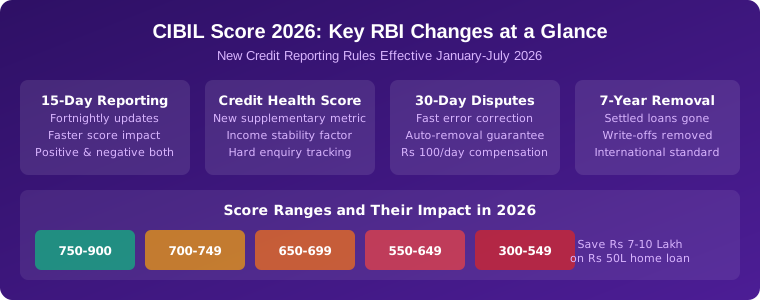
The four major pillars of the new framework are: increased reporting frequency from monthly to fortnightly, introduction of the Credit Health Score as a supplementary metric, a binding 30-day dispute resolution window with compensation for delays, and automatic removal of negative entries after seven years. Each of these changes has significant implications for borrowers and lenders alike.
2. The New 15-Day Reporting Cycle
Starting January 2026, the RBI mandated a fortnightly reporting cycle for all scheduled commercial banks and major NBFCs. Under the old system, lenders reported credit data to bureaus once a month, meaning a 30-45 day lag between your payment and its reflection in your score. Now, credit data is updated every 15 days.
From July 2026, the reporting frequency increased further to four cycles per month — on the 9th, 16th, 23rd, and last day of every month. This means loan repayments now reflect in your CIBIL score within days rather than weeks. Positive actions like paying down credit card balances or closing a loan show up much faster, but missed payments and defaults are also flagged sooner.
This faster feedback loop cuts both ways. If you pay an overdue EMI today, your score could improve within the next reporting cycle. Conversely, a single missed payment can drop your score within 15 days instead of 45 days previously.
3. Credit Health Score — The New Supplementary Metric
The RBI has introduced the Credit Health Score (CHS) as a secondary metric alongside your traditional CIBIL score. While your CIBIL score (300-900) remains the primary benchmark, the CHS factors in additional parameters including income stability signals, frequency of hard enquiries in the last 6 months, and the diversity of credit types (secured vs unsecured).
The CHS will be used primarily by lenders during underwriting and will directly influence approval rates and the interest rate offered. A strong CIBIL score paired with a weak CHS may result in higher rates or additional documentation requirements. This is particularly relevant for borrowers who have recently applied for multiple loans or credit cards, as frequent hard enquiries are flagged by the CHS.
4. Mandatory 30-Day Dispute Resolution
One of the most impactful changes for consumers is the mandatory 30-day dispute resolution window. Previously, credit report disputes could take 45-60 days with no guaranteed outcome. Under the new framework, lenders and bureaus must resolve all disputed entries within 30 calendar days.
If a dispute is not resolved within 30 days, the disputed information must be temporarily removed from the credit report until resolution. Additionally, consumers are entitled to compensation of Rs 100 per day of delay beyond the 30-day deadline — a significant customer-protection right that incentivizes timely resolution of errors.
This change is particularly important because credit report errors are more common than most people realize. Incorrect late payments, accounts that don’t belong to you, or outdated settled status entries can drag down your score by 30-100 points. Under the new rules, these errors can be corrected in a month or less.
5. 7-Year Negative Mark Removal Rule
Any derogatory marks — settled accounts, written-off loans, late payments — must now be removed from your credit file after 7 years, consistent with international best practices. Previously, negative entries could remain indefinitely, continuing to suppress credit scores years after the underlying issue was resolved.
The 7-year clock runs from the date of first default or settlement. For example, a loan settled in 2021 will be automatically removed from your CIBIL report in 2028. This provides a clear path to credit recovery for borrowers who have experienced financial difficulties in the past.
6. How to Improve Your CIBIL Score in 2026
With the new fortnightly reporting, your actions now have faster impact on your score:
- Dispute errors: Under the 30-day rule, a corrected false default can boost your score 30-100 points within a month.
- Reduce credit utilisation: Keep credit card balances below 30% of your limit. With 15-day reporting, this improvement reflects in 15-30 days.
- Pay EMIs on time: Payment history is 35% of your score. Fortnightly reporting means on-time payments boost your score faster.
- Don’t cluster applications: Multiple hard enquiries in a short period signal distress to the CHS model.
- Keep old cards open: Credit age contributes to your score. Closing your oldest card reduces average credit age.
Frequently Asked Questions
Will my CIBIL score change automatically under the new rules?
Not automatically, but it will update more frequently — every 15 days instead of monthly — making it more responsive to your credit behaviour.
Does the Credit Health Score replace my CIBIL score?
No. Your CIBIL score remains the primary benchmark. The CHS is a supplementary lender-side metric. You still need 750+ for the best loan offers.
How much can a 750+ CIBIL score save on a home loan?
On a Rs 50 lakh home loan over 20 years, the difference between a 800+ score and a below-700 score translates to Rs 7-10 lakh in extra interest.
What is the realistic timeline for CIBIL score improvement?
From 650 to 750+: 4-8 months with disciplined payments and reduced utilisation. From below 600 with a settlement on file: 12-18 months for meaningful recovery.
Related Reading
- RuPay Credit Card on UPI in 2026: Complete Guide
- SEBI Mutual Fund Regulations 2026: Key Changes
- SIP Mutual Funds vs Direct Stock Investing in 2026
Sources
- RBI New CIBIL Score Rules 2026 — Complete Guide
- CIBIL Score India 2026 — The Salary Investor
- RBI Tightens Credit Information Reporting Norms from 1 July 2026
- CIBIL Score 2026: What Affects It, RBI Rules — TaxSocial