Key Takeaway: Edge computing in industrial automation processes data locally on IoT gateways rather than sending everything to the cloud, reducing latency to under 10ms, enabling offline operation, and cutting bandwidth costs by up to 90% while maintaining real-time control over CNC machines, PLCs, and sensors.
Table of Contents
1. What Is Edge Computing in Industrial Automation?
Edge computing refers to the practice of processing data near the source of generation rather than sending it to a centralized cloud server. In industrial automation, this means deploying computing resources directly on the factory floor — on IoT gateways, PLCs, or embedded systems — to analyze sensor data, control machinery, and make decisions in real time.
The global edge computing market in manufacturing is projected to reach $11.2 billion by 2027, driven by Industry 4.0 initiatives and the need for real-time data processing. For Indian manufacturers, edge computing offers a path to smart manufacturing without the massive bandwidth costs and latency issues associated with cloud-only architectures.
Edge computing industrial automation addresses three critical factory floor challenges: latency (cloud round-trips can take 100-500ms, too slow for real-time control), bandwidth (a single CNC machine can generate 1TB of data per day), and reliability (internet outages shouldn’t stop production).
2. Edge Computing Architecture for Smart Manufacturing
A typical edge architecture for industrial automation consists of five layers:
Layer 1 — Factory Floor: Sensors, actuators, CNC machines, PLCs, and robotic arms generate real-time operational data. These devices communicate via Modbus RTU/TCP, OPC UA, or Profinet.
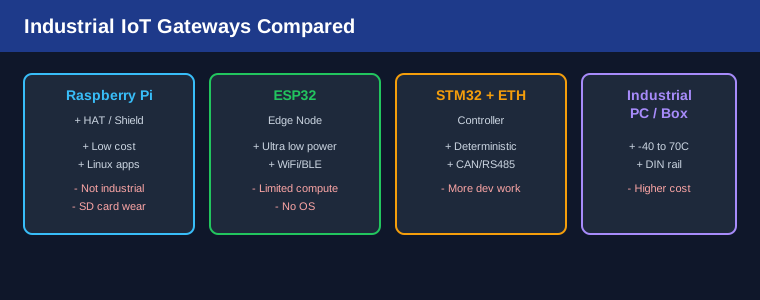
Layer 2 — Edge Gateway: A local computing device (Raspberry Pi, NVIDIA Jetson, or industrial IPC) collects, filters, and processes data. It runs local analytics, performs protocol conversion, and buffers data during network outages.
Layer 3 — Edge Server: Optional but recommended for multi-machine setups. Aggregates data from multiple gateways, runs containerized applications (Docker), and hosts local dashboards using tools like Node-RED or Grafana.
Layer 4 — Cloud Platform: AWS IoT Core, Azure IoT Hub, or Google Cloud IoT receive summarized data for long-term analytics, machine learning model training, and remote monitoring.
Layer 5 — Application Layer: Dashboards, OEE (Overall Equipment Effectiveness) tracking, predictive maintenance alerts, and ERP integration.
This architecture ensures that even if the cloud connection drops, the factory floor continues operating autonomously. Data is stored locally and synced when connectivity is restored.
3. Choosing the Right IoT Gateway Hardware
Selecting the appropriate edge gateway hardware depends on your processing requirements, environmental conditions, and budget. Here are the most common options for Indian manufacturing setups:
Raspberry Pi 5 (Budget-friendly)
Price: ₹5,000-8,000. Ideal for small workshops with 1-3 machines. Runs Node-RED, Python scripts, and lightweight databases. Handles Modbus TCP and basic OPC UA communication well.
NVIDIA Jetson Orin (AI/ML workloads)
Price: ₹30,000-60,000. Required if you’re running computer vision inspection, predictive maintenance ML models, or real-time anomaly detection. Includes GPU acceleration for AI inference.
Industrial Edge Gateway (Production environment)
Price: ₹50,000-2,00,000. Fanless designs with industrial temperature ratings (-20°C to 70°C), DIN-rail mounting, and built-in UPS. Brands like Advantech, Siemens IOT2050, and Bosch Rexroth offer purpose-built solutions.
4. Industrial Protocols and Edge Integration
Connecting edge gateways to factory floor equipment requires understanding industrial protocols. The most common ones in Indian manufacturing include:
Modbus RTU/TCP: The most widely supported protocol. Nearly every PLC, VFD, and energy meter supports Modbus. Edge gateways can poll multiple Modbus devices using Python’s minimalmodbus library or Node-RED’s Modbus nodes.
OPC UA (Unified Architecture): The modern standard for industrial communication. Platform-independent, secure, and supports complex data structures. Open62541 is a popular open-source implementation for edge devices.
MQTT Sparkplug: Designed specifically for Industrial IoT. Adds state management and topic namespacing to standard MQTT. Ideal for edge-to-cloud communication with bidirectional command capabilities.
5. Step-by-Step Implementation Guide
Here’s a practical approach to deploying your first edge computing setup for industrial automation:
Step 1: Assess Your Equipment — Inventory all machines that generate data. Check which support Modbus, OPC UA, or have digital/analog outputs that can be read by a PLC or Arduino-based data acquisition system.
Step 2: Deploy the Edge Gateway — Set up a Raspberry Pi 5 with Raspberry Pi OS Lite. Install Docker, Node-RED, InfluxDB (time-series database), and Grafana. Configure WiFi or Ethernet for machine connectivity.
Step 3: Connect to Machines — Use Modbus TCP to read data from CNC controllers and PLCs. For older machines without digital interfaces, install current transformers and temperature sensors connected to an ESP32 or Arduino, which sends data to the edge gateway via serial or WiFi.
Step 4: Process Data Locally — Write Node-RED flows that filter noisy sensor data, calculate rolling averages, detect threshold violations, and trigger local alerts. Store raw data in InfluxDB for 30-90 days, then summarize and purge.
Step 5: Connect to the Cloud — Forward summarized metrics (OEE, uptime, cycle times, scrap rates) to AWS IoT Core or Azure IoT Hub using MQTT. Use cloud services for long-term trending, multi-factory dashboards, and ML model training.
6. Security Considerations
Edge computing introduces new security surface areas in industrial environments. Critical measures include:
- Change default passwords on all edge devices and industrial equipment
- Segment the OT network from corporate IT using VLANs and firewalls
- Use TLS 1.3 for all MQTT and OPC UA communications
- Enable encrypted storage (LUKS) on edge gateways
- Implement certificate-based authentication for device-to-cloud connections
- Regular firmware updates for edge devices
Frequently Asked Questions
What is the difference between edge computing and fog computing?
Edge computing processes data on the device or gateway itself, while fog computing introduces an intermediate layer between the edge and the cloud for additional aggregation and analysis. For most Indian manufacturing setups, edge computing is sufficient.
Can I use edge computing without internet connectivity?
Yes. One of the primary advantages of edge computing industrial automation is that it operates fully offline. Data is stored locally and syncs to the cloud when connectivity is available.
How much does an edge computing setup cost for a small factory?
A basic setup for a small Indian factory (5-10 machines) costs between ₹30,000-1,00,000, including a Raspberry Pi gateway, sensors, and Node-RED configuration. Industrial-grade solutions start around ₹2,00,000.
What programming skills are needed for edge computing?
Python for data processing scripts, Node-RED for flow-based programming (visual, no-code), and basic Linux administration for managing the edge gateway. Docker knowledge helps with containerized deployments.
Which Indian manufacturers are using edge computing?
Companies like Tata Steel, Mahindra & Mahindra, Bajaj Auto, and several mid-tier automotive suppliers in Pune, Chennai, and Gurgaon have deployed edge computing solutions for predictive maintenance and real-time OEE tracking.
Related Reading
- Build Your Own ESP32 WiFi Smart Switch with Relay Control
- DIY ESP8266 Temperature and Humidity Monitor with Home Assistant Integration
- Getting Started with STM32 Programming for Industrial Applications
Sources
- Gartner — Edge Computing Definition
- OPC Foundation — OPC UA Overview
- Modbus Organization
- AWS IoT Edge Computing
- NVIDIA Jetson for Edge AI
Disclosure: This post contains affiliate links. As an Amazon Associate, we earn from qualifying purchases from linked products.