PLC Selection and I/O Sizing for New Machine or Retrofit
Key Takeaway
PLC selection and io sizing must start from the physical I/O list, because every module, backplane current and CPU choice is downstream of that list. Count every point, split by signal type, add 20 to 30 percent spare capacity, budget the backplane current, and only then choose the controller family.
Figure 1: The order of decisions in PLC selection and I/O sizing, from the wired I/O list up to the platform choice
Table of Contents
1. Start With the I/O List, Not the CPU
Most PLC selection mistakes begin with the CPU. A team picks a controller because a brand is familiar or because a price list was in front of them, and discovers during panel design that the machine needs 96 digital outputs while the base unit has 32. The rework that follows costs panel hours, cable labour and a week of schedule. The reverse order costs nothing. Every decision in plc selection and io sizing flows from one rule: the I/O list is the contract and the CPU is a consequence of it.
Build the list from the machine, not from the catalogue
Walk the machine physically and write down every electrical point, one per line, with the address left blank. A point is a single discrete connection to the PLC: a limit switch, a photoelectric sensor, a solenoid valve, a pilot lamp, a heater contactor enable, a thermocouple. If a signal needs its own analogue channel, it is a point but it is also a channel, and it has a cost per channel that is typically three to ten times the cost per digital point.
Do not merge points because they move together. A cylinder extension and retraction limit switch must both land separately so the program can prove the direction of travel and detect a broken wire. A single 8-point relay output module that switches two pilot lamps and a stack light is three points of load, not one.
Separate the safety points from the standard points
Safety-related devices (emergency stops, guard door switches, light curtains, safety relays) must be listed in a separate table. Many of them will not land on a standard PLC at all. They will be wired into a safety relay or a safety controller and only appear on the PLC as a single “healthy” or “fault” feedback bit. Mixing them into the main I/O list is how a machine ends up with an emergency stop wired to a standard input and no performance level at all. The full treatment is in the machine safety circuits guide.
Add spare capacity before you order
Add 20 to 30 percent spare digital capacity in both directions and at least two spare analogue channels. The justification is empirical rather than theoretical: field changes always exceed the original estimate. A new sensor gets added because a part was slightly out of position, a hydraulic station needs a level switch, a customer’s quality requirement adds a reject conveyor. A modular rack with 30 percent free slots handles this without a second purchase order and a second shutdown.
| Quantity | Typical rule | Why it matters |
|---|---|---|
| Digital inputs | Count + 25 percent spare | Sensor additions during commissioning |
| Digital outputs | Count + 25 percent spare | Rejects, lamps, extra valves |
| Analog inputs | Count + 2 channels spare | Channels are the expensive part |
| Analog outputs | Count + 1 channel spare | Loop retuning and valve replacement |
| High speed / counters | 2 spare channels | Encoder and pulse work appears late |
| Safety I/O | Count + 2 zones spare | Guard additions later |
2. Signal Types Decide the Module Family
Once the points are counted, group them by signal type and electrical behaviour. The group decides the module, and the module decides the backplane budget, the cabinet space and the wiring method.
Digital inputs: 24 V DC sinking is the Indian default
Almost every new machine in an Indian shop runs on 24 V DC control power. Sensors are two-wire or three-wire PNP devices that source current, and the PLC input sinks that current. A 24 V DC digital input on a typical compact controller draws 4.7 to 8 mA per point. On a 16-point module that is 75 to 128 mA, and that current comes off the controller’s 24 V backplane rail, not off a field supply.
Set the input filter deliberately. The default filter on most modules is 10 ms, which means a limit switch that breaks is not visible to the program for up to 10 ms plus one scan. For a fast axis or a press that must stop on a limit, use a 1 ms or 0.5 ms filter on that channel and keep the default on slow signals. Setting every filter to minimum is not a fix, it is a way of injecting noise into the controller.
Digital outputs: relay versus transistor
A relay output switches anything, ignores inductive kick and fails shorted only rarely, but it is slow, it wears, and it costs more. A transistor output switches in microseconds with no moving parts, but it leaks standby current when off and it will die if it is asked to switch an inductive load it was not rated for. The rating that matters is the inductive rating: a module advertised as 2 A per point is usually rated 0.5 A for an inductive load, and a solenoid valve coil is an inductive load. Put a flyback diode across every coil and check the inductive rating separately from the resistive rating.
Analog inputs: current beats voltage past a few metres
Use 4 to 20 mA for every process measurement run more than about three metres. A current signal is immune to voltage drop and to most induced noise, and it distinguishes a broken wire (0 mA) from a genuine zero reading, which a 0 to 10 V signal cannot. For temperature, use the transmitter’s native type: a 4 to 20 mA transmitter for a furnace, an RTD module for a 100 ohm platinum resistance element, and a cold-junction-compensated thermocouple module for a type K or J thermocouple. The scaling detail is in the analogue I/O scaling guide.
The other module families that are not “I/O”
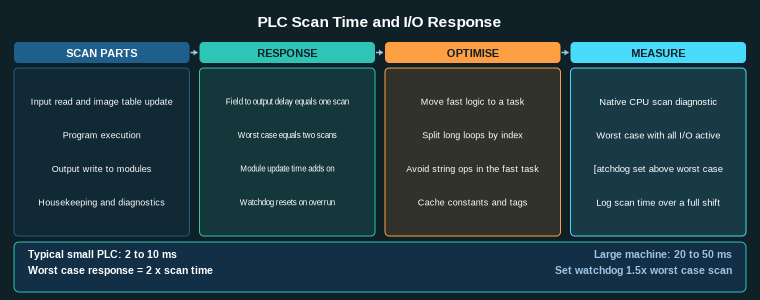
High-speed counters, encoder modules, serial gateways, positioning modules and analogue output modules all consume backplane slots and, in most cases, extra backplane current. Count them as modules in the layout even though they carry no field I/O. A motion control machine usually needs a separate motion CPU or a positioning module because the main CPU cannot close a servo loop inside the cycle time. See the scan time and I/O response guide for that arithmetic.
3. Module Load and Backplane Budget
This is where PLC selection and io sizing becomes arithmetic instead of preference. Every module draws current from the controller’s internal 24 V and 5 V rails, and every controller has a limit for each rail. Exceed it and the symptoms are strange: random resets during a cold start, modules that drop off the bus after a brownout, or a CPU that runs fine until the second shift when the ambient temperature rises.
Typical backplane current per module
| Module type | 24 V backplane | 5 V backplane | Note |
|---|---|---|---|
| CPU (small, 24 V DC supply) | 100 to 300 mA | 80 to 250 mA | Includes processor and memory |
| 16-point digital input | 75 to 130 mA | 20 to 40 mA | About 5 to 8 mA per point |
| 16-point digital output, transistor | 25 to 60 mA | 20 to 40 mA | Output driver logic only |
| 16-point digital output, relay | 60 to 120 mA | 25 to 45 mA | Coil energising draws from the rail |
| 8-channel analog input | 160 to 240 mA | 15 to 30 mA | 20 to 30 mA per channel |
| 4-channel analog output | 80 to 160 mA | 15 to 30 mA | Check the load capability per channel |
| Communication / fieldbus module | 50 to 150 mA | 40 to 120 mA | EtherNet/IP or PROFINET module |
A worked example: 3-axis CNC retrofit panel
Take a retrofit with 68 digital inputs, 44 digital outputs, 6 analog inputs and 2 analog outputs, plus one PROFINET module and one high-speed counter module. Build the load with mid-range values from the table:
- 5 x 16-point DI modules: 5 x (105 mA on 24 V, 30 mA on 5 V) = 525 mA / 150 mA
- 3 x 16-point DO transistor modules: 3 x (40 mA / 30 mA) = 120 mA / 90 mA
- 1 x 8-channel AI module: 200 mA / 25 mA
- 1 x 4-channel AO module: 120 mA / 20 mA
- 1 x PROFINET module: 100 mA / 80 mA
- 1 x high-speed counter: 60 mA / 40 mA
Subtotal: 1125 mA on the 24 V rail and 405 mA on the 5 V rail, before the CPU. Add a CPU that draws 220 mA / 180 mA and the total is 1345 mA on 24 V and 585 mA on 5 V. A controller with a 1.5 A 24 V internal supply and a 1.0 A 5 V supply is at 90 percent and 58 percent respectively. The 24 V rail is the problem, and the fix is a CPU with a larger internal supply or an external 24 V rail with a separate 5 V converter for the bus.
The 80 percent rule
Keep the calculated backplane load under 80 percent of the supply rating on both rails. The 20 percent headroom is not conservatism for its own sake. It absorbs the inrush of relay outputs all switching simultaneously at machine start, it gives room for the two spare analogue channels the machine will need, and it accounts for the supply module ageing. Indian supply voltage is nominally 415 V three-phase 50 Hz, but the actual input at the panel regularly swings from 340 V to 460 V, and a power supply with a narrow input window is a future failure.
Field wiring voltage drop
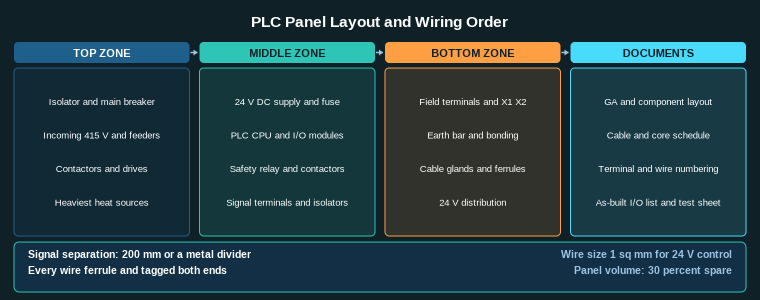
The backplane is inside the cabinet and the drop is small. The field side is where the drop matters. Copper resistivity is 0.0175 ohm mm2/m, so a 1.5 mm2 conductor is 0.01167 ohm per metre and the loop resistance of a 30 m run is 2 x 30 x 0.01167 = 0.70 ohm. A 2 A solenoid on that run sees a 1.4 V drop, which is 5.8 percent of 24 V, and some valves will chatter or fail to pull in when the supply dips. The same current on 2.5 mm2 falls to 0.42 ohm and 0.84 V. The full calculation is in the PLC panel design and wiring guide.
4. Choosing the CPU Class
With the I/O list and the backplane budget done, the CPU choice narrows to a small number of classes. Selecting the smallest class that fits is standard practice in PLC selection and io sizing, but “smallest that fits” means fits with margin, not fits exactly.
| Class | Typical capacity | Use it for | Indicative Indian price |
|---|---|---|---|
| Compact | 20 to 64 local points, 1 expansion | Small conveyors, fillers, test rigs | INR 45,000 to 1,10,000 |
| Modular | 150 to 600 points, hot swap, fieldbus | Machine tools, multi-station lines | INR 1,20,000 to 4,00,000 |
| Motion / PAC | Modular plus motion CPU and buses | 3 to 8 axis CNC, robotics cells | INR 3,00,000 to 9,00,000 |
| Safety PLC | Safety logic, F-CPU, PROFIsafe | Complex machine safety, many zones | INR 2,50,000 to 8,00,000 |
Platform choice is a support decision
Among Indian integrators the common platforms are Delta and Ladder (Delta DVP series), Siemens SIMATIC S7-1200 and S7-1500, Mitsubishi MELSEC iQ-R and iQ-F, Omron NX and CP, and Schneider Electric Modicon and M221/M241. All of them are capable. The differentiator is the local service network and the spares shelf.
Ask three questions before choosing: who services the machine within 100 km, can a replacement CPU be on the bench in 48 hours, and is the ladder code portable if the customer later insists on another brand. A machine in Pune running a German PLC with no local distributor will sit for a week every time the CPU fails, and that downtime cost dwarfs any hardware saving. On the other hand, if the customer’s own maintenance team writes the code, the open IEC 61131-3 programming languages matter more than the brand, because the project stays maintainable when the supplier changes.
Memory, task structure and communications
Give the program memory at least five times the size the initial program will occupy. Programs always grow, and the growth is not linear: the first version fits in 20 KB, the version with three new machine options and diagnostics fits in 60 KB, and the version with a touch screen HMI, recipe handling and an OPC UA server fits in 140 KB. Out of memory on a controller that does not support memory cards is an expensive afternoon.
On the communication side, count the ports you will actually use: a PROFINET or EtherNet/IP port to the drives, a port to the remote I/O, a port to the HMI, a port to the plant network and a service port. Five ports on a CPU costs more than a CPU with two ports plus a cheap switch, and the switch adds a failure point. Plan for at least one spare port.
5. Retrofit Versus New Build
In a retrofit the constraint is not the I/O list, it is the hardware already installed. The first question is whether the existing I/O modules can be kept, and that question is answered by three checks.
- Type check. Is the existing I/O 24 V DC digital, or is it an older 5 V or 110 V AC system? Mixing a 24 V DC module into a 110 V AC panel is a rework, not a reuse.
- Condition check. Relay outputs with millions of operations have visible contact wear and a measurable contact resistance. Pull the modules, measure a few contacts, and check for pitting.
- Compatibility check. Can the existing modules run on a different CPU? Almost never across brands. Within a family, a new CPU almost always drives old modules, but the reverse is rarely true.
When the existing modules are healthy and the family is supported, reusing them cuts the hardware cost substantially and keeps the spare parts strategy simple. When the modules are relay-output type and the new machine adds a fast positioning axis, replacing them with transistor outputs is usually worth the money, because the relay modules contribute to the response time and to the panel heat load.
Budget for the hidden retrofit costs that are usually forgotten: re-terminating every field wire onto new terminal blocks, the cable schedules that have to be re-documented, the 415 V supply and earthing that has to be brought up to current practice, and the safety circuit that has to be redesigned to ISO 13849 even if the original machine never had one. The safety rebuild alone is often 20 to 30 percent of the automation hardware cost. The light curtain and interlock guide covers that scope.
6. Spares, Lifecycle and Indian Support
Three variables decide whether a controller is still worth buying new: the vendor’s published lifecycle phase, the availability of the module in India, and the firmware support commitment.
A controller in “active” or “maintenance” phase is a safe purchase. A controller in “end of life” phase with a published last-order date is a bad purchase even at a discount, because the spare module will stop existing in 18 months and you will be maintaining your own stock. Before you commit, ask the distributor for the price and lead time of a single replacement CPU and of one digital input module. If they cannot quote a single module without a minimum order quantity of 50, the platform has no real support in your region.
Keep spares in three categories. One spare CPU, one spare module of each type in the panel, and a complete program backup with a version history. That last one is free and is the item most often missing. A machine delivered with the program on a lost USB stick and no revision record loses a week the first time somebody adjusts a timer.
The panel power budget also needs checking at this stage, because the controller choice drives it. Use the control cabinet power budget calculator to size the transformer and the air conditioning for the cabinet, and read the control panel cooling and IP rating guide for ambient derating in a 45 deg C shop.
7. Paperwork That Saves the Project
The I/O list is not an office task. It is the document the cabinet is built from, the document the program is written against, and the document the maintenance engineer uses five years later to add a sensor. Produce it in a table with one row per point, with columns for tag name, description, signal type, module and slot, address, and the terminal number.
The address column must match the actual hardware configuration and the program, and it must be checked against the running machine before handover. A 2 percent address mismatch rate on a 200-point machine is four points, and each one is an afternoon of debugging that will happen during production when the machine is already making money.
Three documents leave the project together with the machine: the as-built electrical schematic, the I/O list with every address, and the program backup with its version history. Add the safety test procedure and the software version manifest and you have a handover package that lets a stranger diagnose a fault at 2 am. More detail on the commissioning sequence is in the Industrial Automation Engineering guide, which is the parent chapter for this whole series.
Related Reading
- Industrial Automation Engineering: Practical Guide
- PLC Panel Design and Wiring: Layout, DIN Rail and Documentation
- PLC Scan Time and I/O Response: Optimising Machine Cycle Latency
- Control Cabinet Power Budget Calculator
Sources
- IEC 61131-3, Programmable controllers – Programming languages
- IEC 61158, Industrial communication networks – Fieldbus
- Delta Electronics, DVP Series Programmable Logic Controllers Manual
- Siemens, SIMATIC S7-1200 Programmable Controller System Manual
Key Takeaways
- The I/O list is the contract. The CPU is a consequence of it, so count every wired point before choosing a model.
- Budget the 24 V and 5 V backplane current separately and keep both under 80 percent of the supply rating.
- Add 20 to 30 percent spare digital capacity and 2 spare analog channels, because field changes always exceed the initial estimate.
- In a retrofit, the existing I/O hardware usually sets the controller choice. Check the module library before buying new CPU hardware.
- Indian shop floors run at 40 to 45 deg C ambient, so horizontal-mount derating and 60 deg C rated devices are not optional.