Retrofitting a Manual Mill vs an Old CNC: Which Gives Better ROI
Key Takeaway
A cnc retrofit manual mill vs cnc decision is decided by mechanical condition and work mix, not by the age of the machine. Converting a heavy manual bed gives the larger percentage gain because you start further from automation, while retrofitting an old CNC gives the lower risk because the mechanics and the workholding are already proven.
Figure 1: Manual mill conversion and old CNC retrofit compared on cost, throughput gain and payback
Table of Contents
- 1. Two Different Problems Wearing the Same Name
- 2. The Honest Comparison, Line by Line
- 3. The Deciding Question Is Mechanical Condition
- 4. The Arithmetic of Both Routes
- 5. Work Mix and Machine Fit
- 6. The Spindle Question That Decides Manual Conversions
- 7. A Decision Checklist You Can Use Today
- Related Reading
- Sources
1. Two Different Problems Wearing the Same Name
Two machines, two questions, one budget. This guide works through the choice a shop actually faces – whether to convert a heavy manual mill or to bring an old CNC back to life – with the costs, the throughput gain and the payback calculated the same way for both, so the comparison is honest. The sections work from the mechanical condition, through the arithmetic of both routes, to a checklist you can run today.
The phrase “CNC retrofit” covers two projects that share a name and almost nothing else. One takes a machine that has no axes and gives it three. The other takes a machine that already has three axes, a spindle and a workholding system, and replaces its brain.
When someone asks which gives better ROI, they are usually asking a question about the machine in front of them, not about the abstract comparison. But the comparison is worth making because the two projects have different failure modes, different budgets and different payback curves, and shop owners who think of them as one category routinely overpay.
The manual mill case
A manual mill of 20 to 30 years vintage in an Indian toolroom is usually a Bridgeport-style machine with a cast iron head, a knee or a belt-driven table feed, and manual leadscrews on the handwheels. Its bed is heavy and its ways are ground and lapped. That is exactly the right starting point for a conversion, because the structure is what you cannot buy later.
The old CNC case
An old CNC is usually a 1990s VMC with a Fanuc 0M or 6M, or a Siemens 802, running on an electronics board with a 30-year-old power supply, out-of-production encoder modules and a membrane keyboard. Its mechanics are CNC mechanics: hardened ground ways, ball screws, a powered downfeed, a chip conveyor and a coolant system. Those are assets. The problem is that the electronics are unserviceable.
Section summary. The framing matters more than the numbers: converting a manual mill and retrofitting an old CNC are different problems that share a name, and treating them as the same decision is how shops end up with the wrong machine. cnc retrofit manual mill vs cnc only means something once the machine class is fixed, because a manual mill and an old CNC differ in spindle, workholding and drive train before any cost is counted.
2. The Honest Comparison, Line by Line
| Parameter | Manual mill conversion | Old CNC retrofit |
|---|---|---|
| Indicative cost | Rs 4 to 9 lakhs | Rs 7 to 18 lakhs |
| Lead time | 6 to 12 weeks | 4 to 8 weeks |
| Throughput gain | 60 to 90 percent | 25 to 40 percent |
| Spindle | Usually manual, needs a new one | Usually powered, may be reusable |
| Drive train | All new: screws, motors, drives | Ball screws often reusable, motors new |
| Workholding | Manual vises and T-slots | Already a CNC table with T-slots |
| Biggest risk | Bed and ways condition | Unknown drive wear and geometry |
| Typical payback | 5 to 12 months | 9 to 24 months |
The gain column is the one people argue about, and it needs explanation. The manual mill gains more because it starts further from the goal. A manual operator takes 6 minutes to set an offset and feed a part; a CNC takes 30 seconds. The old CNC already had the automatic cycle, so replacing the control returns a smaller share of the lost time but does so more reliably.
Where the money goes differently
In a manual conversion, roughly 60 to 70 percent of the budget goes into the drive train, because everything from the ballscrew down is new. In an old CNC retrofit, the drive train is often 40 to 50 percent, because the ball screws, the ballscrew nuts and sometimes even the servo motors can be reused if they are healthy. That is where a useful rule comes from: on an old CNC, the budget goes to control and to electrical; on a manual mill, the budget goes to mechanics and to the spindle.
Section summary. The comparison line by line shows where the two routes differ in kind, not just in amount. The old CNC already has a spindle, workholding and a powered downfeed, so its budget goes to control and electrical. The manual mill has none of that, so cnc retrofit manual mill vs cnc becomes a question of mechanics and a new spindle, and the percentage gain is larger because the machine starts further from automation.
3. The Deciding Question Is Mechanical Condition
Strip away the economics and one variable decides most of these projects: is the structure still good?
The manual mill test
Cast iron machine tool beds do not fatigue the way welded steel does. A cast iron bed from 1985 with a scraped way surface and a gib adjusted correctly will still hold position for another fifteen years. But cast iron is brittle, and cast iron does crack. Before converting, check:
- Cast the bed and the column for cracks, especially around the way supports and the coolant pipe penetrations. A dye penetrant check costs a few thousand rupees and is worth every rupee of it.
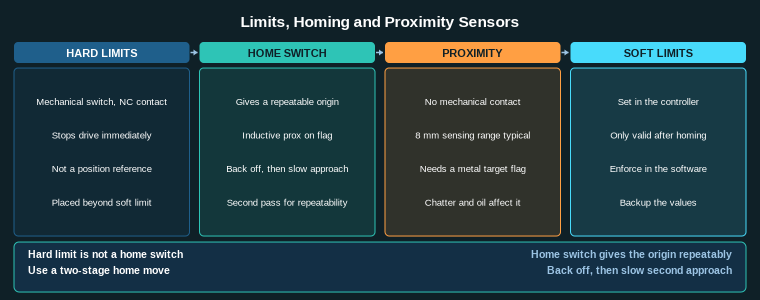
- Check the ways for rust pitting. Surface rust that cleans off is acceptable. Pitting that you can feel with a fingernail means the way needs a scrape, which is expensive but recoverable.
- Check the column guides and the knee, if it has one, for wear and for any play in the gibs.
- Look for the head and table T-slots for wear and chipping.
The heavy-casting test is a good shortcut: a manual mill that weighs 1.2 tonnes or more usually has a bed worth building on. A 400 kg bench-top manual machine usually does not have the rigidity for a serious conversion.
The old CNC test
An old CNC’s structure was already built for machining forces, so the bed is rarely the problem. The problems are the drive train and the geometry:
- Measure ballscrew backlash with a dial indicator and a spring scale. Push the table against the screw in one direction, then the other. A reading above 0.03 mm on a machine that will cut to 10 micron tolerance is a rebuild, not a fix.
- Check for backlash compensation working in both directions. If the control has never been able to hold it, the screw is worn.
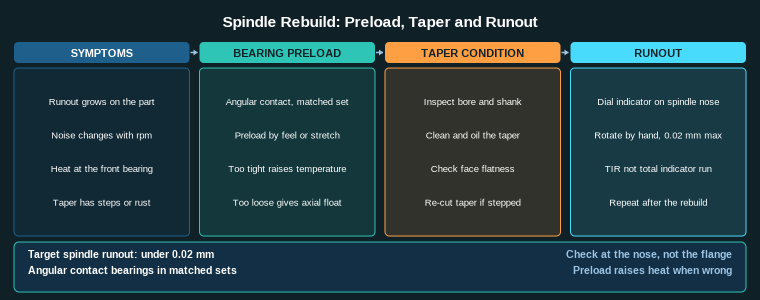
- Check the spindle bearing noise and the spindle runout at the nose with an indicator, turning it by hand. Above 0.03 mm total indicator reading, the spindle needs bearings.
- Check the way wear with a blueing and a straightedge, and look for the tell-tale gap at the table ends.
The full scoring method is in the parent retrofit guide. The rule of thumb from that guide is that a survey score below 12 out of 30 means the money is better spent on a new machine.
Section summary. The variable that decides most of these projects is not cost and not age: it is whether the structure is still good. A cast iron bed that has been scraped and re-gibbed will carry another fifteen years of cutting load; a tired CNC bed with a worn screw and a noisy spindle will not. When the mechanical condition is the deciding factor, cnc retrofit manual mill vs cnc becomes a survey exercise rather than a budget exercise.
4. The Arithmetic of Both Routes
Two worked cases on the same shop, using the same cost and benefit assumptions, so the comparison is honest.
Case A: manual mill conversion
Machine: 1986 manual vertical mill, 700 by 300 mm travel, 1.4 tonne, handwheels with ACME screws, T-slotted table, manual spindle with 2 HP motor and a belt drive.
- New ball screws, 2508 with 5 mm lead, 3 axes: Rs 0.62 lakhs
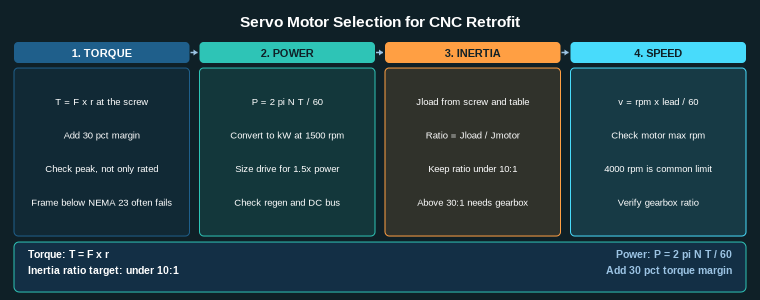
- NEMA 23 closed-loop steppers with drives, 3 axes: Rs 1.05 lakhs
- 1.5 kW spindle, VFD 2.2 kW, spindle head rebuild: Rs 0.48 lakhs
- Controller, I/O, cabinet, wiring: Rs 0.72 lakhs
- Limit switches, home sensors, E-stop, safety relay: Rs 0.11 lakhs
- Mechanical rebuild: scrape ways, fit gibs, tram, new drawbar: Rs 0.62 lakhs
- Electrical, commissioning, training: Rs 0.48 lakhs
- Contingency 10 pct: Rs 0.41 lakhs
Total: Rs 4.49 lakhs, round to Rs 4.5 lakhs.
Benefit: the manual cycle is 14 minutes, the CNC cycle is 3.5 minutes, so 10.5 minutes saved per part. With 450 shifts a year and 8 usable hours per shift of benefit, that is 3600 hours a year, and at 4 parts per hour of saved time that is 14,400 parts a year. At a Rs 160 contribution margin, that is Rs 23.04 lakhs a year, which is far beyond demand for most shops, so capacity limits it. Assume the shop can absorb 7,000 extra parts a year: 7000 x 160 = Rs 11.2 lakhs a year. Plus scrap reduction from repeatable offsets, say Rs 2.4 lakhs a year. Total benefit Rs 13.6 lakhs a year. Payback = 4.5 / 13.6 = 0.33 years, about 4 months. Even if you halve the benefit for optimism, payback stays under a year.
Case B: old CNC retrofit
Machine: 1998 VMC, 800 by 400 by 500 mm travel, Fanuc 0M, ball screws with 0.08 mm backlash, BT30 spindle that runs well, powered downfeed, chip conveyor.
- New servo motors and drives, 3 axes: Rs 2.95 lakhs
- New ball screws, 2508 with 10 mm lead, preloaded: Rs 0.85 lakhs
- Absolute encoders: Rs 0.32 lakhs
- Spindle VFD 7.5 kW: Rs 0.42 lakhs
- Controller, I/O, cabinet, wiring: Rs 0.55 lakhs
- Limit switches, prox, E-stop, safety relay: Rs 0.12 lakhs
- Spindle rebuild and taper work: Rs 0.28 lakhs
- Mechanical rebuild: ways, gibs, tramming: Rs 0.95 lakhs
- Electrical, commissioning, training: Rs 0.73 lakhs
- Contingency 10 pct: Rs 0.72 lakhs
Total: Rs 7.89 lakhs, round to Rs 8 lakhs.
Benefit: the old control was a Fanuc 0M with a failing power supply and an intermittent axis, so the machine was running at 60 to 70 percent of its rated capacity, with more setup time and more rework. A new control with reliable servos brings it to 95 percent of rated capacity. Assume the improvement is 25 percent of output: the machine makes 10,000 parts a year now and 12,500 after, and at Rs 160 contribution that is Rs 40 lakhs a year of gross contribution, but only the incremental output that the market absorbs counts. Assume 1,200 extra parts a year: Rs 1.92 lakhs. Plus reduced rework, Rs 3.1 lakhs a year, plus labour freed from manual offset setting and probing, Rs 0.65 lakhs a year. Total benefit Rs 5.67 lakhs a year. Payback = 8 / 5.67 = 1.41 years, about 17 months.
What the two cases show
The manual conversion costs 44 percent less and pays back in about a quarter of the time. But the case assumes a heavy, sound machine and a shop with demand for more parts. If the manual mill is a light machine with worn ways, the mechanical rebuild line grows from Rs 0.62 lakhs to Rs 2.5 lakhs or more, the total moves past Rs 6.5 lakhs, and the advantage narrows sharply.
Section summary. The two worked cases use the same cost and benefit assumptions deliberately, so the comparison in cnc retrofit manual mill vs cnc is a like-for-like comparison. The manual conversion costs less and pays back faster, but only because the assumption about machine condition holds. That assumption is the thing to test on your own machine before you believe the result.
5. Work Mix and Machine Fit
Cost is only half the decision. The machine has to do the work.
When the manual mill wins on fit
- The work is small batches of one-off and short-run parts where setup dominates. A manual machine loses 2 to 4 minutes per setup, and that is exactly what a CNC removes.
- The shop is short of skilled CNC operators but has good manual machinists. This is a real and common situation in Indian job shops, and it is one of the strongest arguments for conversion.
- Parts are small, and a dedicated CNC mill of the right size costs more than the manual machine plus conversion. For small work on a big manual bed, conversion can be the cheaper path to automation.
When the old CNC wins on fit
- The work is production work with repeat cycles, and the old machine’s rigidity and workholding are already matched to it.
- The spindle is an asset. A working BT30 or CAT40 taper with good bearings is worth Rs 1.5 to Rs 3 lakhs to replace, and a manual mill’s spindle is the single most expensive item in a conversion.
- The machine is already installed, levelled and connected to the shop’s coolant, chip conveyor and power. That installed cost is already sunk.
- The old machine has a downstream integration. If it already feeds a work cell or a production line, replacing it disrupts something that works.
The trap: doing both badly
The worst outcome is converting a manual machine for production work that needs a proper CNC. A converted manual mill has a spindle with more runout, a table with less rigidity against side load, and no chip conveyor. It will produce parts that pass inspection and then fail on tolerance in the customer’s assembly. If the work is production work, buy or retrofit a real CNC.
Section summary. Cost is half the decision and fit is the other half, and the fit question is where cnc retrofit manual mill vs cnc is usually decided. Small batch one-off work, a shop short of CNC operators but strong on manual machinists, or parts too small to justify a dedicated CNC all point toward conversion. Production work with an expensive scrap cost points toward the old CNC.
6. The Spindle Question That Decides Manual Conversions
For a manual conversion the spindle is where the budget surprises people. A manual mill’s original spindle is an air-cooled or gear-head spindle with a taper that is usually BT30 or the older BT, run at 1,500 rpm maximum, with spindle runout of 0.02 to 0.05 mm at best and far more once the spindle is worn.
The options
| Option | Cost (Rs lakhs) | Max speed | Runout achievable | Verdict |
|---|---|---|---|---|
| Keep manual, add hand taps and drill chuck | 0 to 0.15 | 1,500 rpm | Unchanged | Not a CNC spindle. Automatic tool change will not work. |
| New 2.2 kW AC servo spindle with BT30 | 0.85 to 1.4 | 6,000 rpm | 0.005 to 0.01 mm | The sensible answer for general job work |
| New 3.5 to 5.5 kW VFD induction spindle | 0.45 to 0.8 | 8,000 to 10,000 rpm | 0.01 to 0.02 mm | Cheaper, but rigid-tapping and tool change need care |
| Used CAT40 taper spindle with erector collet | 0.6 to 1.2 | 8,000 rpm | 0.008 mm typical | Good value if you can inspect it first |
Runout is the number to check. A spindle that will run out 0.02 mm will produce surface finish that is limited by that 0.02 mm, no matter how accurate the axes are. The spindle rebuild procedure, the bearing preload work and the taper inspection method are in the spindle rebuild guide.
The rigid tapping trap
Many converted manual mills get a VFD-driven spindle with a pulley or an erector, and then rigid tapping does not work because the spindle is not a servo with a position feedback. Rigid tapping needs the spindle to hold a commanded position while the axis feeds into it. If the work needs tapping, either specify a servo spindle with position feedback, or budget for a tapping head. Do not discover this after the machine is built.
Section summary. For a manual conversion the spindle is where the budget surprises people, and it is the item most often left out of a cnc retrofit manual mill vs cnc comparison. The spindle is what a manual mill does not have and an old CNC does, and it decides whether the machine can cut a tolerance or only make a shape. The rigid tapping trap is the second thing to check, because it is expensive to discover late.
7. A Decision Checklist You Can Use Today
Run these in order for the machine in front of you. The first one that fails ends the process for that machine.
- Is the bed structurally sound? No cracks, no pitting in the ways, columns straight. If no, stop: buy a new machine or find a better candidate.
- Is there demand for the output? Calculate the extra parts per year and check them against the order book. If the shop has no demand for them, only labour and scrap benefits count, and the payback lengthens.
- What is the spindle worth? For an old CNC, this is usually a large number. For a manual mill, it is usually zero, so budget Rs 0.45 to 1.4 lakhs.
- What is the drive train condition? Old CNC ball screws under 0.03 mm backlash can be kept. Manual mills have nothing to keep.
- Can the shop support it? Open control and steppers need a maintainer who can learn it. Proprietary controls need a service network within 500 km. Use the LinuxCNC hardware guide for the open route and the cost calculator guide for the budget.
- Is the bed rigid enough for the target tolerance? A converted manual mill on a light casting will not hold 10 micron on a steel part. Know the limit before you promise it.
The final practical point: if both routes are viable for the same shop, do the manual conversion first, because it gives the bigger percentage gain, it teaches the shop what CNC actually costs in time and money, and it de-risks the old CNC retrofit if you do that one later.
Section summary. The checklist is the usable output of cnc retrofit manual mill vs cnc, and it is ordered so that the first failure ends the process for that machine. Structural condition comes first because no budget can fix a cracked bed. Demand, spindle value, drive train condition, service support and achievable tolerance follow. If both routes survive the checklist, do the manual conversion first.
Related Reading
- CNC Machine Retrofit: Complete Guide
- CNC Retrofit Cost Calculator
- Retrofitting a Manual Mill vs an Old CNC: Which Gives Better ROI
- CNC Retrofit Troubleshooting
Sources
- IMTMA, CNC Retrofit Guidance for Indian MSME Toolrooms
- LinuxCNC Documentation, Hardware Compatibility
- ISO 10360, Test conditions for geometric accuracy of numerically controlled machines
- Ministry of MSME, Credit Linked Capital Subsidy Scheme
Key Takeaways
- Converting a manual mill typically costs Rs 4 to 9 lakhs and gives a 60 to 90 percent throughput gain; retrofitting an old CNC costs Rs 7 to 18 lakhs and gives 25 to 40 percent.
- The single deciding factor is mechanical condition: a heavy cast iron manual bed usually converts better than a tired old CNC bed.
- An old CNC usually has a better spindle and better workholding, so the retrofit budget goes to control and drives instead of to mechanical rebuild.
- Compare payback on labour freed and scrap reduced, not on additional output, because demand is rarely the binding constraint in an Indian shop.
- Never convert a manual machine whose bed is cracked or whose ways are rusted through; the frame has to carry the machining load, not the axis load.