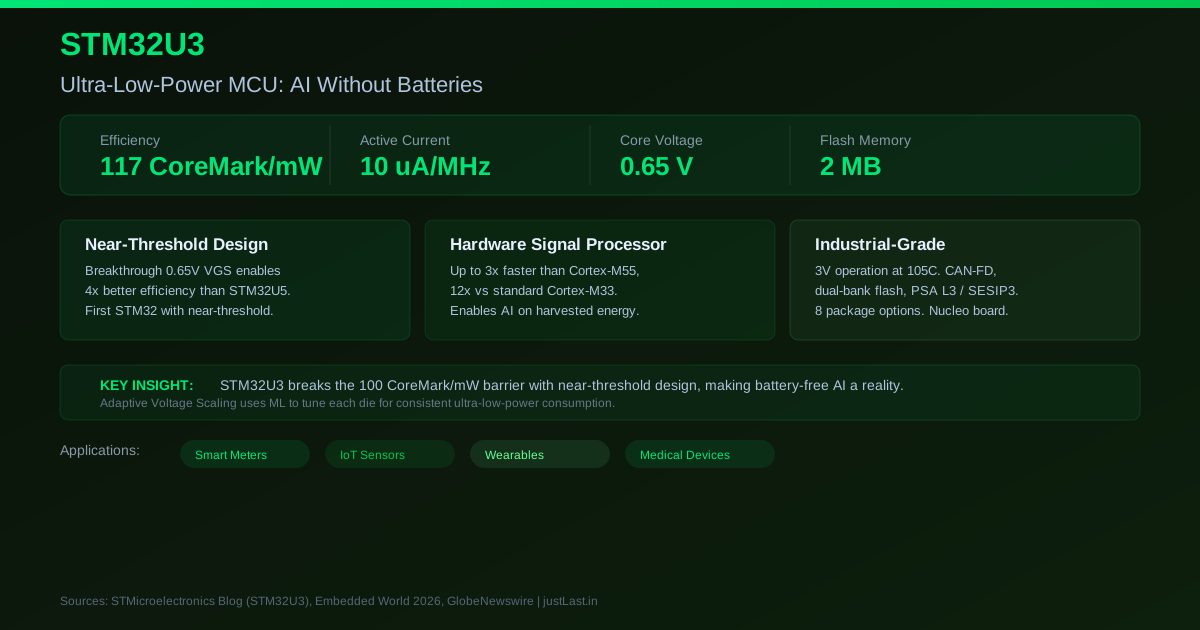
Key Takeaway: The STM32U3 is the first STM32 microcontroller to use near-threshold design, achieving a remarkable 117 CoreMark/mW at just 10 uA/MHz active current. With its hardware signal processor (HSP) delivering up to 12x better DSP performance than a standard Cortex-M33, it can run neural network inference on energy harvested from solar cells, thermal gradients, or vibration — truly AI without batteries. This makes it ideal for maintenance-free industrial sensors, smart meters, and medical wearables.
Table of Contents
1. The Ultra-Low-Power Breakthrough
The STM32U3 microcontroller series from STMicroelectronics represents a fundamental rethinking of what ultra-low-power (ULP) processing can achieve. In March 2026, ST announced the STM32U3B5/C5 models with 2 MB of Flash and the new hardware signal processor (HSP), establishing a new benchmark for energy efficiency in the microcontroller industry.
The headline number is 117 CoreMark per milliwatt. For context, the STM32U5 — itself a respected ULP device — achieves 53.9 CoreMark/mW. The STM32U3 more than doubles this figure, and most competing devices from other manufacturers hover below 100. This breakthrough in efficiency is made possible by ST’s near-threshold design, a technique that has remained largely theoretical until ST brought it into volume production.
At Embedded World 2026, ST demonstrated a neural network inference running entirely on energy harvested from ambient room light using a small solar cell. The STM32U3 was performing real-time gesture recognition with no battery connected — a demonstration that underscores the transformative potential of this technology for maintenance-free IoT sensors.
2. Near-Threshold Design: How It Works
CMOS transistors have a threshold voltage (VT) — the minimum gate-to-source voltage (VGS) required to create a conducting channel between source and drain. In conventional digital circuits, the supply voltage (VCORE) is set well above VT — typically 1.0V to 1.2V for 40nm and 28nm MCU processes — to ensure reliable switching despite manufacturing variations.
Operating closer to VT dramatically reduces power consumption because dynamic power scales with the square of voltage (P = CV^2f). However, near-threshold operation has historically been impractical due to three challenges: reduced switching speed, extreme sensitivity to voltage variations, and die-to-die variability that makes consistent manufacturing difficult.
ST solved these challenges through a combination of proprietary process optimizations and a novel testing methodology. The key innovations include:
Process Engineering: ST optimized the lithographic processes to enable reliable operation at a minimum VCORE of 0.65V (typical 0.75V). This is nearly half the voltage of conventional MCUs, directly translating to significantly lower power consumption.
Adaptive Voltage Scaling (AVS): Each STM32U3 die is individually tested at the factory, and a machine learning algorithm automatically tunes voltage and timing parameters to account for die-to-die variations. This ensures consistent ultra-low-power consumption across every chip that ships, eliminating the variability problem that has historically plagued near-threshold designs.
Thermal Tolerance: The STM32U3 operates at up to 3V and 105 degrees Celsius, tolerating far harsher environments than typical near-threshold circuits. The leakage current is significantly lower than competing solutions, enabling reliable operation in industrial conditions.
The result is a Cortex-M33 core running at 96 MHz — a practical speed for most sensor-processing applications — while consuming approximately 960 uA at full speed operation.
3. Hardware Signal Processor (HSP)
The STM32U3B5/C5 models introduce a new hardware signal processor (HSP) that fundamentally extends what an ultra-low-power MCU can achieve. The HSP is an embedded signal accelerator that handles DSP and machine learning workloads that would overwhelm the Cortex-M33 core if executed in software.
The performance numbers are striking: the HSP achieves up to 3x higher DSP performance than a Cortex-M55 and up to 12x compared with a standard Cortex-M33 — all while consuming a fraction of the power of the CPU core. For applications running on coin cells or harvested energy, this efficiency gap translates directly into longer operating life or smaller, cheaper power sources.
Practical applications enabled by the HSP include always-on voice activation for battery-powered devices, real-time vibration analysis for predictive maintenance sensors, ECG signal processing in wearable monitors, and environmental classification (sound, motion, temperature patterns) for smart building sensors.
The HSP is supported through STM32Cube.AI Studio and NanoEdge AI Studio, allowing developers to train models on their desktop and deploy them directly to the STM32U3 without manual optimization. The toolchain automatically maps neural network operations to the HSP for maximum efficiency.
4. AI Without Batteries: Energy Harvesting Demos
The most compelling demonstration of the STM32U3’s capabilities was at Embedded World 2026, where ST showed neural network inference running on power harvested from ambient light. A small solar cell — the type used in pocket calculators — provided enough energy to run continuous AI inference on the STM32U3 with no battery or supercapacitor backup.
This is possible because the STM32U3’s total system power at 96 MHz is under 1 mW, and it can enter deep sleep modes (including the new STOP3 mode) that consume mere nanowatts while retaining wakeup capabilities. The combination of active-mode efficiency and advanced low-power modes creates a device that can spend 99% of its time in deep sleep, wake up in microseconds, process sensor data with the HSP, make an inference decision, and return to sleep — all within the energy envelope of a small solar cell or thermoelectric generator.
Other energy sources that can power the STM32U3 include thermal gradients (using a TEG module on a warm pipe), vibration (piezoelectric harvester on industrial machinery), RF harvesting (from ambient WiFi or cellular signals), and tiny coin cells that last for years rather than months.
5. Industrial Applications and Ecosystem
The STM32U3 targets applications where battery replacement is impractical or impossible. Key use cases include:
Smart Gas and Water Meters: Maintenance-free meters that send daily readings over wireless networks without battery changes for 10+ years. The HSP enables real-time flow analysis and leak detection on the meter itself.
Industrial GPS Trackers: Location tracking for shipping containers, pallets, and assets that must operate for years on a small battery. The STM32U3’s STOP3 mode with wakeup capability is ideal for periodic reporting.
Predictive Maintenance Sensors: Vibration and temperature sensors on motors and conveyors that run machine learning models to predict failures before they happen, powered by energy harvested from the machine’s own vibration.
Medical Wearables: Continuous patient monitoring devices that must be small, lightweight, and long-lasting. The STM32U3’s HSP can process ECG or SpO2 signals in real time while consuming minimal power.
Building Automation: Wireless temperature, humidity, occupancy, and air quality sensors that never need battery replacement. The STM32U3 can run for 5+ years on a single CR2032 coin cell.
The ecosystem includes 8 package options from 3x3mm to larger configurations for designs with space constraints. ST provides Nucleo evaluation boards for rapid prototyping, and the STM32CubeMX2 tool simplifies configuration. Security certifications include PSA Level 3 and SESIP Level 3, with features like CCB (Cryptographic Context Barrier) for secure key transmission.
6. STM32U3 vs STM32U5 vs Competitors
| Feature | STM32U3 | STM32U5 | Competitor ULP |
|---|---|---|---|
| Core | Cortex-M33 @ 96 MHz | Cortex-M33 @ 160 MHz | Various |
| CoreMark/mW | 117 | 53.9 | <100 |
| Active Current | 10 uA/MHz | 19 uA/MHz | 15-25 uA/MHz |
| Min VCORE | 0.65V | 1.0V | 1.0-1.2V |
| Flash Memory | 2 MB | 4 MB | 1-2 MB |
| DSP Accelerator | HSP (3-12x vs M33) | FPU only | None |
| Security | PSA L3 / SESIP L3 | PSA L3 / SESIP L3 | Varies |
The STM32U3 sacrifices some peak CPU performance and memory density versus the STM32U5, but its efficiency advantage and HSP acceleration make it the superior choice for energy-constrained applications that need DSP or ML capabilities.
7. Frequently Asked Questions
What is the power consumption of the STM32U3 at 96 MHz?
Approximately 960 uA at 96 MHz active operation, or 10 uA/MHz. In STOP3 sleep mode, consumption drops to nanowatts level with fast wakeup capability.
Can the STM32U3 really run AI without a battery?
Yes. ST demonstrated neural network inference powered entirely by ambient light harvesting. The combination of 117 CoreMark/mW efficiency, the HSP accelerator, and advanced sleep modes enables periodic AI inference on harvested energy.
What is the HSP and how is it programmed?
The Hardware Signal Processor is a dedicated accelerator for DSP and ML workloads that achieves up to 12x better performance than the Cortex-M33 core for signal processing tasks. It is programmed through STM32Cube.AI Studio and NanoEdge AI Studio, which automatically map neural network operations to the HSP.
What packages are available for the STM32U3?
ST offers 8 package options for the STM32U3 series, from compact 3x3mm packages for space-constrained designs to larger configurations with more I/O pins for complex applications. Nucleo evaluation boards are available for prototyping.
How does STM32U3 compare to the competition for wearable applications?
The STM32U3’s 0.65V operation and 10 uA/MHz active current make it the most efficient option for battery-powered wearables. The HSP enables on-device sensor processing that competing ULP MCUs would need to send to the cloud, saving both power and latency.
Related Reading
- STM32V8 Microcontroller: World’s First 18nm Cortex-M85 MCU
- STM32 in Industrial IoT: Building Precision Sensor Data Acquisition Systems
Sources
- STMicroelectronics Blog — STM32U3: Ultra-Low-Power with HSP and 2 MB Flash
- Embedded World 2026: STMicroelectronics Demonstrations
- STMicroelectronics Newsroom — STM32C5 and New MCU Families
Disclosure: Some links in this article are affiliate links. As an Amazon Associate, we earn from qualifying purchases. We may earn a commission if you purchase STM32 development boards or components through the links at no additional cost to you.