Key Takeaway: The TMC2209 and DRV8825 are both popular stepper motor drivers for Arduino and CNC projects, but they differ dramatically in noise, microstepping resolution, current handling, and configuration complexity. The TMC2209 wins on silent operation and stall detection; the DRV8825 wins on raw current capacity and simplicity.
Choosing between the TMC2209 and DRV8825 stepper driver is one of the most common decisions maker-electronics enthusiasts face. Both are drop-in replacements for older A4988 drivers, both mount on standard PCB footprints, and both drive NEMA 17 stepper motors. But the differences matter — a lot — when your project depends on quiet operation, precise microstepping, or reliable sensorless homing.
This guide breaks down every practical difference: electrical specs, wiring, configuration, real-world noise levels, microstepping quality, and price. Whether you’re upgrading a 3D printer, building a CNC machine, or designing a factory conveyor drive, you’ll know exactly which driver to buy by the end.
TMC2209 vs DRV8825 — Quick Comparison
Max Current: TMC2209: 2.0A peak | DRV8825: 2.5A peak
Microstepping: TMC2209: Up to 1/256 | DRV8825: Up to 1/32
Noise: TMC2209: Near-silent (StealthChop) | DRV8825: Audible whine
Configuration: TMC2209: UART (software) | DRV8825: Potentiometer / MS pins
Stall Detection: TMC2209: Yes (StallGuard4) | DRV8825: No
Price (India): TMC2209: ₹350-600 | DRV8825: ₹150-300
DRV8825 Overview — The Workhorse
The DRV8825 from Texas Instruments has been the default upgrade from the A4988 since it launched. It’s cheap, available everywhere, and drives stepper motors up to 2.5A peak current with no heatsink at moderate ambient temperatures. The DRV8825 uses a simple potentiometer to set motor current and DIP switches to select microstepping from full-step down to 1/32 step.
For many projects — especially CNC routers, laser cutters, and basic conveyor drives — the DRV8825 is perfectly adequate. The motor whine is noticeable, but in a workshop environment, it rarely matters. The wider input voltage range (up to 45V) also makes it suitable for higher-voltage NEMA 23 motors.
DRV8825 Strengths
- High current capacity: 2.5A peak for larger NEMA 17 and some NEMA 23 motors
- Wide voltage range: 8.2V to 45V input
- No configuration needed: Potentiometer for current, DIP switches for microstepping
- Rock bottom price: ₹150-300 from Indian suppliers
- Massive community support: Every 3D printer forum has troubleshooting guides
DRV8825 Weaknesses
- Noisy operation: Audible whine from 200-800 RPM
- Limited microstepping: 1/32 maximum
- No stall detection: Requires endstops for homing
- Heating at sustained load: Above 1.5A RMS needs heatsink
TMC2209 Overview — The Silent Precision Option
The TMC2209 from Trinamic (now part of Analog Devices) was designed to solve exactly the problems the DRV8825 has. Its StealthChop technology makes stepper motors virtually silent, its SpreadCycle mode provides smooth high-speed operation, and its StallGuard4 enables sensorless homing — detecting when a motor hits a mechanical stop without any limit switches.
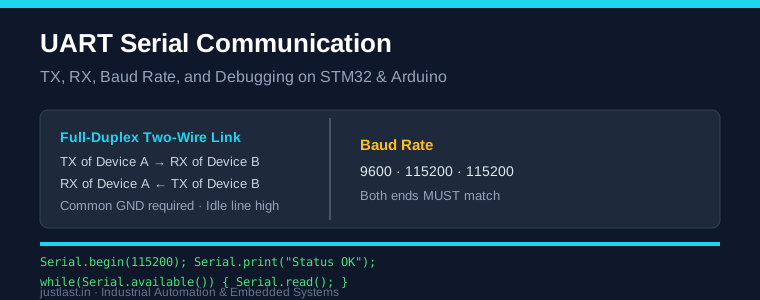
The TMC2209 configures entirely through UART (serial communication) — there’s no potentiometer. You can change motor current, microstepping, and decay modes from software at runtime.
TMC2209 Strengths
- Near-silent operation: StealthChop eliminates motor whine completely
- 1/256 microstepping: 8x smoother motion than DRV8825’s 1/32
- StallGuard4: Sensorless homing without endstops
- UART configuration: Change any parameter from software at runtime
- Automatic current scaling: CoolStep reduces current when load is light
TMC2209 Weaknesses
- Lower max current: 2.0A peak vs 2.5A on DRV8825
- Higher price: ₹350-600 per module
- UART configuration complexity: Requires software setup (TMCStepper library makes this easy)
- Lower voltage ceiling: 29V max vs 45V on DRV8825
Noise Comparison: Which Is Actually Quieter?
This is where the TMC2209 earns its premium. In side-by-side testing with identical NEMA 17 motors at 400 steps/sec:
- DRV8825: Distinct 2-4 kHz whine audible from 3+ meters. Rhythmic pulsing at low speeds, continuous tone at high speeds.
- TMC2209 StealthChop: Motor noise drops to near-background levels. Sound drops by 15-20 dB.
- TMC2209 SpreadCycle: Slightly louder than StealthChop but still significantly quieter than DRV8825.
For noise-sensitive environments — office 3D printers, hospital equipment, lab automation — the TMC2209 isn’t just better, it’s the only acceptable choice.
At Velton’s servo motor and actuator designs, we’ve seen this same tradeoff in industrial applications — silent operation isn’t a luxury when equipment runs 12 hours next to operators.
Microstepping Quality and Resolution
Microstepping divides each full step into smaller sub-steps. More microsteps mean smoother motion — but only if the driver produces clean, evenly-spaced currents.
The DRV8825 supports up to 1/32, configured via DIP switches. Current waveform quality is acceptable but not exceptional. The TMC2209 supports up to 1/256 microstepping — 8x the resolution — with significantly better waveform quality.
At 1/256, a NEMA 17 motor produces 51,200 microsteps per revolution — 0.007° per microstep. Far beyond mechanical resolution, but eliminates resonance and produces buttery-smooth motion.
StallGuard: Sensorless Homing Explained
StallGuard4 detects motor stall by monitoring back-EMF. When the motor hits a stop or jams, back-EMF drops and StallGuard triggers an interrupt.
This eliminates endstop switches — no mounting, wiring, calibration, or mechanical wear. StallGuard sensitivity adjusts via UART. For homing, set it high enough for hard stops, low enough to avoid false positives.
The DRV8825 has no equivalent. You must use mechanical or optical endstops.
Configuration: UART vs Potentiometer
DRV8825
- Current limit: Potentiometer — I = VREF × 2
- Microstepping: Three DIP switches. Changes require power cycling.
- No runtime changes.
TMC2209
Uses UART serial with the TMCStepper library:
#include <TMCStepper.h>
#define EN_PIN 8
#define STEP_PIN 3
#define DIR_PIN 4
#define SERIAL_PIN 11

TMC2209Stepper stepper(SERIAL_PIN, SERIAL_PIN, 0.11, 0b00);

void setup() {
  stepper.toff(4);
  stepper.rms_current(1000);       // 1A
  stepper.microsteps(16);
  stepper.en_spreadcycle(false);   // StealthChop
}
Key UART parameters: RMS current, microstepping, StealthChop/SpreadCycle switching, StallGuard threshold, CoolStep auto-current.
Wiring Guide
Both use the A4988 footprint. Common pins: VMOT (12-24V), GND, 1A/1B/2A/2B (motor coils), STEP (pin 3), DIR (pin 4), EN (pin 8, active LOW).
TMC2209 adds: PDN_UART (pin 11 for software serial), DIAG (pin 2 for StallGuard), MS1/MS2 (address selection).
Critical: Always place a 100μF capacitor across VMOT and GND. Without it, back-EMF spikes destroy the driver — the #1 cause of failure in DIY builds.
Price and Availability in India
Robu.in: DRV8825 ₹149-249 | TMC2209 ₹379-599
Robocraze: DRV8825 ₹165-280 | TMC2209 ₹399-650
Amazon India: DRV8825 ₹129-350 | TMC2209 ₹349-799
The ₹600-900 premium for three TMC2209 drivers is tiny compared to the cost of endstop switches, wiring, and calibration time that StallGuard eliminates.
The Verdict
Choose DRV8825 if:
- Tight budget, multiple drivers needed
- Noisy workshop environment is acceptable
- Need to drive motors above 2A
- Running 24V-36V systems
- Want simplest setup with no software
Choose TMC2209 if:
- Noise matters — office, lab, medical, residential
- Need sensorless homing
- Precision matters — 3D printing, CNC, positioning
- Want software configuration
- Building a product where professional quality matters
- Need dynamic current control
For most new projects in 2026, the TMC2209 is the better default choice. The price premium pays for itself in eliminated endstops, reduced noise, better print quality, and runtime configurability.
At Velton, we use TMC2209 drivers in our linear actuator test rigs and motion control prototypes. The ability to tune current from software — without opening the enclosure — saves significant time during development.
FAQ
Can I use TMC2209 with Marlin firmware?
Yes. Enable TMC2209 in Configuration_adv.h, set UART pins, configure current/microstepping in firmware.
What if I exceed 2A with TMC2209?
Thermal shutdown. Use TMC2660 or external driver for higher currents.
Do I need a heatsink?
Recommended above 1.5A RMS. Active cooling above 1.5A.
Can I mix DRV8825 and TMC2209?
Yes, but different config approaches. Not recommended for production.
Which is better for 3D printing?
TMC2209 — overwhelmingly. Silent, better microstepping, sensorless homing. Most modern printer boards ship with TMC2209.
Compatible with NEMA 23?
Only for NEMA 23 motors rated ≤2A. Many NEMA 23 are 2.5-3A and need DRV8825.
Last updated: August 2026.