

Key Takeaway: Predictive maintenance with industrial IoT combines vibration, temperature and current sensors with machine learning models running on edge gateways and the cloud, letting factories detect equipment faults weeks before failure and cut unplanned downtime by up to 30%.
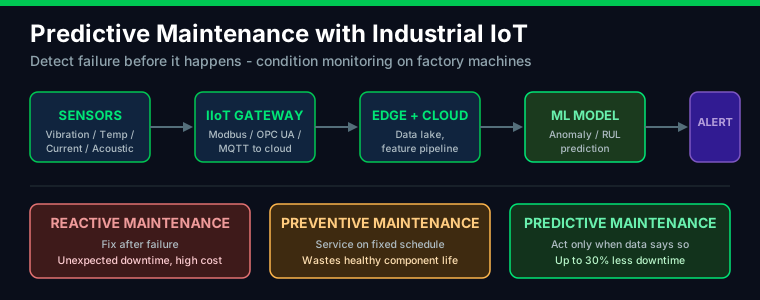
Table of Contents
- 1. What Is Predictive Maintenance in Industrial IoT?
- 2. Reactive vs Preventive vs Predictive: Why Factories Are Switching
- 3. The IIoT Architecture Behind Predictive Maintenance
- 4. Key Sensors and Data Sources for Condition Monitoring
- 5. Machine Learning Models for Failure Prediction
- 6. Step-by-Step Implementation for a Factory Floor
- 7. Costs, ROI and Real-World Results
- 8. FAQ
- 9. Related Reading
- 10. Sources
1. What Is Predictive Maintenance in Industrial IoT?
Predictive maintenance is a maintenance strategy that uses continuous machine condition data to predict when equipment will fail, so you can repair or replace it at the optimum moment. In an industrial IoT (IIoT) setup, sensors mounted on motors, pumps, spindles and conveyors stream data through a gateway to software that learns each machine’s normal behaviour and flags deviations long before a breakdown.
The concept itself is not new – condition monitoring has existed since the 1990s with portable vibration analysers. What changed is cost. A MEMS accelerometer that costs a few hundred rupees today, combined with an ESP32 or STM32 gateway that converts Modbus to MQTT, gives even a small workshop the telemetry that previously required a dedicated vibration lab.
For Indian factories running mix of imported and indigenous machinery, predictive maintenance is especially valuable because spare parts and service engineers are often days away. Knowing that a bearing has 300 operating hours of life left converts an emergency shutdown into a scheduled job during a shift change.
2. Reactive vs Preventive vs Predictive: Why Factories Are Switching
Most factories still operate on one of two older strategies. Reactive maintenance fixes equipment after it fails – the machine runs until something breaks, then production stops while you scramble. Preventive maintenance replaces parts on a fixed schedule, for example every 2,000 hours, regardless of actual condition. Both have serious drawbacks.
Reactive maintenance causes unpredictable downtime, emergency purchasing premiums and secondary damage (a failed bearing can destroy a spindle). Preventive maintenance wastes the useful life of healthy components – a bearing replaced at 2,000 hours might have lasted 6,000 – and every unnecessary teardown carries its own risk of introducing faults.
Predictive maintenance sits between the two. The machine tells you, through data, that a fault is developing, and you intervene at the point of maximum value. Industry studies consistently report that predictive maintenance driven by IIoT data reduces unplanned downtime by 30-50% and lowers overall maintenance costs by 15-25%.
3. The IIoT Architecture Behind Predictive Maintenance
A production-ready predictive maintenance industrial iot system has five layers: sensing, acquisition, connectivity, analytics and action.
Sensing. Low-cost sensors measure the physical signals that indicate wear – vibration, temperature, current draw, acoustic emission and lubricant quality. Acquisition. A microcontroller or dedicated data acquisition board samples the sensor at the right rate. Connectivity. An industrial gateway aggregates multiple machines over Modbus RTU or OPC UA and publishes to MQTT. If you are designing this link, our guide to RS485 and Modbus RTU communication with Arduino and STM32 covers the wiring and protocol details.
Analytics. The cloud or an edge device runs the machine learning model. Edge processing handles real-time anomaly detection; the cloud stores history, retrains models and generates reports. Action. Alerts flow to a maintenance dashboard or work-order system so the right technician is dispatched with the right spare part.
Where you place the analytics matters. Fast loops (bearing fault detection, spindle imbalance) belong at the edge because they need millisecond decisions and cannot tolerate network latency. Slow loops (trend analysis, remaining useful life estimation) belong in the cloud. Our comparison of edge computing deployment for smart manufacturing walks through this split in detail.
4. Key Sensors and Data Sources for Condition Monitoring
Choosing the right sensor is the difference between a system that works and one that produces noise. The most common signals in industrial predictive maintenance are:
Vibration. The single most diagnostic signal for rotating machinery. Faults in bearings, gears, imbalance and misalignment all have characteristic vibration frequencies. Use an accelerometer with a sensitivity band of at least 0-5 kHz for general machines and 0-20 kHz for high-speed spindles. MEMS accelerometers such as the ADXL345 or MPU6050 are fine for slow machines; industrial IEPE accelerometers are needed above a few kilohertz.
Temperature. A sudden rise in bearing or motor winding temperature usually precedes failure. Thermocouples and PT100 RTDs are cheap, robust and easy to retrofit.
Current draw. Motor current rises as mechanical load increases due to wear. A current transformer on one phase, sampled by an energy monitoring IC, reveals both load creep and electrical faults.
Acoustic emission. Ultrasonic emissions occur when micro-cracks open and surfaces rub. AE sensors detect defects earlier than vibration but cost more and need specialist interpretation.
Lubricant condition. For critical gearboxes, oil debris and moisture sensors detect metal particles that signal internal wear.
The rule of thumb: instrument the machines whose failure costs the most – bottleneck machines, quality-critical processes and equipment with long repair lead times. Start with five to ten machines rather than the whole plant.
5. Machine Learning Models for Failure Prediction
Once data is flowing, you need models to interpret it. Three families of approaches cover almost all factory use cases.
Threshold and statistical methods. The simplest and often the most reliable start. Set baselines for RMS vibration, peak acceleration and temperature from healthy operation, then alarm when values exceed 2-3 standard deviations. No training data is needed, and for a first deployment this alone catches most failures.
Anomaly detection. Autoencoders, isolation forests and one-class SVMs learn the normal distribution of your sensor data and flag anything that does not fit. These models are ideal when you have plenty of healthy data but almost no failure examples – the normal situation in a well-run factory.
Remaining useful life (RUL) prediction. Regression models and recurrent networks estimate how many operating hours remain before a component reaches its failure threshold. RUL is the model that moves you from “something is wrong” to “replace this bearing at the next shift change.”
Be realistic about maturity. Many factories get 80% of the benefit from vibration thresholds plus a simple anomaly score, without any deep learning. Add an ML model only after you have six months of clean labelled data. As the MQTT-based remote monitoring architecture guide explains, the data pipeline matters more than the model at the start.
6. Step-by-Step Implementation for a Factory Floor
Here is a pragmatic rollout path that works for an SME factory, not just a large plant.
Step 1 – Pick pilot machines. Choose 5-10 machines that are production bottlenecks. Instrument vibration and temperature on each.
Step 2 – Build the data path. Connect sensors to a gateway. If machines already have PLCs, tap the PLC registers over Modbus. Otherwise use standalone IoT nodes. Publish to an MQTT broker with data quality tags.
Step 3 – Collect baseline data. Run for two to four weeks capturing healthy-operation data. Do not skip this – every threshold you later set depends on it.
Step 4 – Set alarms. Start with statistical thresholds on RMS vibration and temperature. Validate them against known maintenance records.
Step 5 – Add models. Once the pipeline is stable, train an anomaly detection model and, later, an RUL model. Retrain monthly.
Step 6 – Close the loop. Route alerts to the maintenance team with a standard work order template. Track every predicted failure to measure accuracy, and every missed failure to improve the models.
For the wireless and edge components, the Raspberry Pi factory monitoring build shows a complete low-cost reference implementation you can adapt.
7. Costs, ROI and Real-World Results
A pilot system for ten machines can be assembled with vibration sensors at roughly $20-60 each, an ESP32 or Raspberry Pi gateway at $10-50, and open-source software (Node-RED, InfluxDB, Grafana) at zero licence cost. Including installation, a meaningful pilot often lands under $2,000 – a fraction of the cost of one unplanned spindle or gearbox failure.
Return on investment comes from several streams: fewer emergency stoppages, longer component life (you stop replacing healthy parts), lower overtime and expedited freight costs, and better production planning because downtime becomes predictable. Factories that close the loop and act on alerts typically report payback in under twelve months, with the majority of the benefit coming from avoiding the single most expensive failure mode on their bottleneck machine.
The biggest practical risk is not the technology – it is alert fatigue. If the system alarms constantly and the team learns to ignore it, the whole program collapses. This is why threshold calibration and a disciplined follow-up workflow are more important than the choice of ML model.
Frequently Asked Questions
What is the difference between predictive maintenance and industrial IoT?
Predictive maintenance is the maintenance strategy; industrial IoT is the technology stack that enables it. Predictive maintenance with industrial IoT means using connected sensors, gateways and machine learning to forecast failures – IIoT provides the data pipeline, predictive maintenance is the business outcome.
Which sensors are used in predictive maintenance?
Vibration accelerometers, temperature probes (PT100/thermocouples), motor current transformers, acoustic emission sensors and oil condition sensors are the most common. Vibration plus temperature covers the majority of rotating equipment failures.
Can small factories afford predictive maintenance?
Yes. A pilot on 5-10 machines can be built for under $2,000 using MEMS sensors, an ESP32 or Raspberry Pi gateway and open-source analytics software. Start with statistical thresholds before investing in machine learning.
Does predictive maintenance need machine learning?
No. Statistical thresholds on vibration and temperature catch most failures. Machine learning – anomaly detection and RUL models – adds value after you have several months of clean baseline data, and should be introduced incrementally.
How much downtime does predictive maintenance reduce?
Published case studies consistently report 30-50% reduction in unplanned downtime and 15-25% reduction in maintenance costs once the system is mature and alerts are acted upon reliably.
Related Reading
- ESP32 Industrial IoT Gateway: Building a Modbus to MQTT Bridge
- MQTT-Based Remote Monitoring System for Industrial Machinery
- Edge Computing in Industrial Automation: IoT Gateway Deployment
- RS485 and Modbus RTU Communication for Industrial Automation
- OPC UA vs MQTT: Choosing the Right Industrial IoT Protocol
Sources
- IBM: What is Predictive Maintenance?
- MathWorks: Predictive Maintenance for Machines
- ISA InTech: Industrial Automation and Condition Monitoring
- Control Engineering: Predictive Maintenance Benefits
- Fluke: Predictive Maintenance Basics
Disclosure: This post may contain affiliate links. If you purchase through these links, we may earn a commission at no extra cost to you. Recommendations are based on engineering merit, not affiliate revenue.