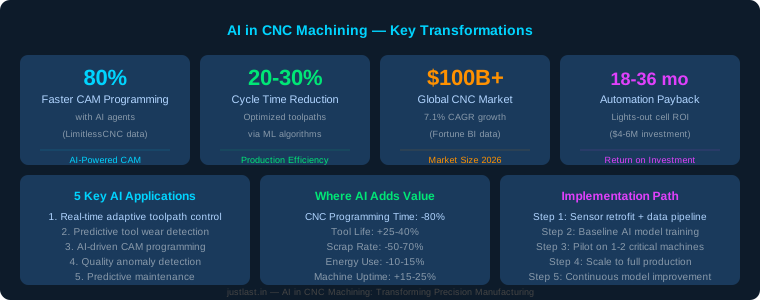
Key Takeaway: AI in CNC machining has moved decisively from experimental pilots to production reality in 2026. AI agents now cut CAM programming time by up to 80%, machine learning models predict tool wear weeks in advance, and real-time adaptive control adjusts feeds and speeds based on sensor feedback. Shops that adopt AI-driven machining gain 20-30% cycle time reductions, 50-70% lower scrap rates, and 15-25% higher machine uptime. The $100B+ global CNC market is being reshaped by artificial intelligence, and early adopters are building competitive advantages that will compound over the next decade.
📖 Table of Contents
1. The AI Revolution in CNC Machining
The integration of AI in CNC machining represents the most significant shift in precision manufacturing since the transition from manual mills to computer numerical control in the 1960s. In 2026, this transformation is accelerating rapidly. The global CNC machining market has surpassed $100 billion, growing at 7.1% CAGR, and artificial intelligence is the primary driver of that growth.

AI in CNC machining is not a single technology but a collection of capabilities: machine learning models that analyze historical production data, computer vision systems that inspect parts in real time, AI agents that generate optimized toolpaths, and sensor fusion algorithms that predict machine health. Together, these technologies are enabling shops to move from reactive to predictive manufacturing.
Startups like LimitlessCNC are developing AI agents that reduce CNC programming time by up to 80%, addressing a critical labor shortage in the industry. The company, founded during the Israel-Hamas war when founder David Priev identified inefficiencies in traditional CNC programming while manufacturing critical components for frontline troops, has already deployed its platform at a Tier-1 Western manufacturer operating more than 250 CNC machines.
The return on investment is compelling. A survey by NIST found that 80% of manufacturers expect to increase their use of AI over the next two years. AI-driven shops see 20-30% cycle time reductions, 25-40% longer tool life, 50-70% scrap rate reductions, and 15-25% higher machine uptime. These improvements compound across production lines, transforming shop floor economics.
2. AI-Powered CAM Programming
Computer-Aided Manufacturing (CAM) has traditionally required skilled programmers with years of experience to manually create CNC machining instructions. This bottleneck has become critical as experienced programmers retire and fewer young workers enter the field. AI-powered CAM addresses this directly.
LimitlessCNC’s AI agents optimize workflows by learning from historical machining data and simulating the physics of metal cutting. The system integrates with existing CAM software, enabling adoption without extensive retraining. Physics-based AI ensures that toolpaths are optimized for precision, speed, and cost efficiency for every new production process.
Other CAM platforms are following suit. Siemens NX and Autodesk Fusion Manufacturing now offer AI-assisted toolpath generation that predicts machining time within 10% accuracy and automatically suggests optimal cutting parameters. For a typical aerospace part requiring 3-4 hours of manual CAM programming, AI reduces this to 30-45 minutes while often producing superior toolpaths.
3. Predictive Tool Wear Detection
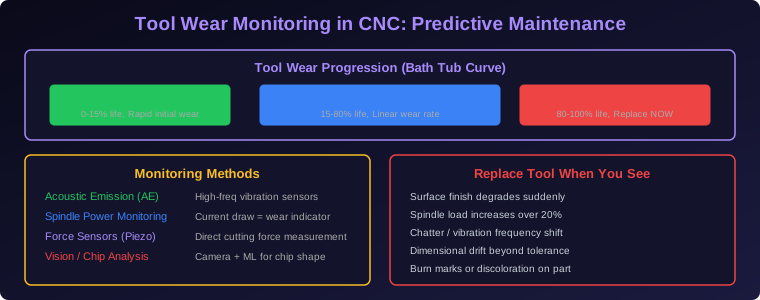
Tool wear prediction has emerged as the killer application for AI in CNC machining. AI models analyze acoustic emissions, cutting forces, spindle power consumption, and vibration signatures to predict tool failure days or even weeks before traditional methods would trigger replacement.
The economic impact is substantial. Unplanned tool changes during production cause scrap, rework, and downtime. By predicting tool wear precisely, shops can schedule tool changes during planned maintenance windows, extend tool life by using controlled adaptive cutting strategies, and reduce scrap rates from tool-related defects.
Machine learning approaches for tool wear detection include Isolation Forest for anomaly detection (identifying unusual vibration patterns), Random Forest classifiers for categorizing wear states, LSTM neural networks for time-series prediction of remaining useful life, and autoencoders for learning normal machine behavior and flagging deviations.
4. Real-Time Adaptive Machining Control
Traditional CNC machining operates on fixed programs. The machine follows the G-code regardless of actual conditions — tool wear, material variations, thermal expansion, or vibration. AI-driven adaptive control changes this paradigm.
Real-time sensor feedback from spindle motors, accelerometers, thermal sensors, and vision systems continuously feeds an AI model that adjusts feeds, speeds, and toolpaths on the fly. When the AI detects increased cutting forces from tool wear, it reduces feed rate to maintain surface quality. When vibration patterns indicate chatter, it adjusts spindle speed to find a stable cutting region.
This closed-loop control results in more consistent surface quality, fewer production halts, and the ability to push machines closer to their performance limits without risking catastrophic failure. Shops implementing adaptive control report 15-25% improvements in overall equipment effectiveness (OEE).
5. AI for Quality Assurance
Quality inspection in CNC machining has traditionally been an offline process — measure the part after machining, identify defects, and scrap or rework. AI enables in-process quality assurance. Computer vision systems mounted inside CNC machines monitor surface finish, dimensional accuracy, and feature geometry during cutting.
These systems can detect developing quality issues before they produce scrap. For example, an automotive supplier experiencing high defect costs due to paint or plastic inconsistencies can use AI to connect environmental conditions, machine settings, and production outputs in real time. Even a modest reduction in defects protects margin and reduces waste significantly.
AI-powered quality systems also feed data back into the CAM system, creating a closed loop where quality data from production improves future toolpaths and machining parameters. This continuous improvement cycle is one of the most powerful benefits of AI integration.
6. How to Implement AI in Your Shop
Implementing AI in CNC machining does not require a multi-million dollar transformation. The most successful adopters follow a phased approach:
Step 1 – Sensor Retrofit and Data Pipeline: Install vibration, temperature, and power sensors on 1-2 critical machines. Set up a data pipeline using open-source tools like MQTT (Mosquitto), InfluxDB for time-series storage, and Grafana for visualization. Total hardware cost per machine is approximately ₹8,000-15,000.
Step 2 – Baseline AI Model Training: Collect 2-4 weeks of normal production data. Train baseline machine learning models for anomaly detection (Isolation Forest) and tool wear classification (Random Forest). Free open-source libraries like scikit-learn and TensorFlow make this accessible.
Step 3 – Pilot on Critical Machines: Deploy AI monitoring on 1-2 high-value machines that cause the most downtime when they fail. Measure baseline OEE, scrap rate, and tool consumption before and after AI deployment.
Step 4 – Scale to Full Production: Once the pilot demonstrates ROI, expand sensor deployment and AI monitoring across all critical machines. Integrate AI insights into existing maintenance workflows and production scheduling.
Step 5 – Continuous Model Improvement: AI models improve with more data. Establish a process for reviewing model predictions, incorporating new failure modes, and retraining models periodically.
Frequently Asked Questions
How is AI used in CNC machining in 2026?
AI is used for automated CAM programming, predictive tool wear detection, real-time adaptive machining control, quality assurance through computer vision, and predictive maintenance. Most AI adoption is pragmatic — augmenting operator decision-making rather than full autonomy.
Can AI reduce CNC programming time?
Yes. Companies like LimitlessCNC report up to 80% reduction in CNC programming time using AI agents that optimize toolpaths based on historical machining data and physics simulations. This directly addresses the skilled labor shortage in manufacturing.
What is the ROI of AI in machining?
Typical returns include 20-30% cycle time reduction, 25-40% longer tool life, 50-70% lower scrap rates, and 15-25% higher machine uptime. Most shops recoup their initial AI investment within 6-18 months through reduced downtime and improved efficiency.
Do I need expensive new machines for AI?
No. AI sensor retrofit kits can be installed on existing CNC machines for ₹8,000-15,000 per machine. The software stack is largely open source. The key requirement is reliable data collection, not new hardware.
Is AI going to replace CNC machinists?
AI is augmenting, not replacing, skilled machinists. The role is shifting from manual operation to data analysis and process optimization. The labor shortage makes AI a tool for preserving and extending the capabilities of existing skilled workers, not eliminating them.
Related Reading
- CNC Machining in 2026: 5 Key Trends Reshaping Precision Manufacturing
- STM32 Motor Control with Field-Oriented Control
- Edge AI in Industrial IoT 2026
Sources
- Startup Develops AI Agents to Automate CNC Machining — Manufacturing.net
- Why Your ERP is Now a Liability — Manufacturing.net
- Future-Proofing Manufacturing Operations With AI — Forbes
- AI on the Factory Floor: Small Investments, Large Returns — Manufacturing.net
- The Rise of AI in US Manufacturing — NIST
Disclosure: Some links in this article are affiliate links. We may earn a commission if you purchase through these links at no additional cost to you.