Key Takeaway: Reducing CNC machining time by 25-40% is achievable through smart CAM strategies like trochoidal adaptive clearing, 3+2 roughing, rest machining, and proper toolpath optimization — without compromising quality or tool life.
Table of Contents

1. Why Machining Time Matters
In CNC manufacturing, time is money — directly. Every minute saved on a machining cycle translates into real cost reduction, especially in production runs of hundreds or thousands of parts. A 30% reduction in cycle time can mean the difference between a profitable job and a loss leader.
But the goal isn’t just to make the machine run faster. The goal is to remove material more efficiently while maintaining or improving surface finish, tool life, and dimensional accuracy. Smart CAM strategy is the lever that makes this possible.
2. Trochoidal & Adaptive Clearing Strategies
Trochoidal milling (also called adaptive clearing or dynamic milling) is arguably the single most effective time-reduction strategy in modern CAM. Instead of the traditional approach of cutting with the full width of the tool (which generates high heat and tool wear), trochoidal paths use a constant small radial engagement with the full flute length.
Why it saves time:
- Constant chip load means consistent cutting conditions — no sudden engagement spikes
- Full flute utilization distributes heat evenly, extending tool life 2-3x over conventional pocketing
- Higher axial depths of cut (up to 2x tool diameter) remove material faster per pass
- Reduced radial engagement (typically 5-15% of tool diameter) allows faster feed rates
In practice, switching from conventional pocketing to adaptive clearing can reduce roughing time by 30-40% on most geometries. The key parameter to tune is the radial engagement angle — start at 10% of tool diameter and adjust based on tool deflection and machine rigidity.
3. 3+2 vs Simultaneous 5-Axis Strategy
One of the most effective time-saving strategies in 5-axis machining is the hybrid 3+2 + simultaneous approach. The idea is simple:
- Rough in 3+2 (positional) mode: Lock the rotary axes at a fixed angle and use high-speed 3-axis toolpaths. This is faster, safer, and allows aggressive chip loads.
- Finish in simultaneous 5-axis mode: Use full 5-axis motion only where needed — typically for complex surfaces, undercuts, or areas requiring tight tolerances.
This strategy reduces full-simultaneous cutting time by 60-70% compared to running the entire job in simultaneous mode. Since most of the material is removed during 3+2 roughing, tool life improves and collision risk drops dramatically.
For shops new to 5-axis, starting with 3+2 machining is also the safest way to build confidence before moving to simultaneous operations.
4. Rest Machining & OptiRough
Rest machining (also called rest roughing or OptiRough) is a CAM strategy that detects uncut areas left by a previous larger tool and generates toolpaths to remove only that remaining material. This avoids the common trap of running the same toolpath twice over already-cleared areas.
How to implement rest machining effectively:
- Start with the largest tool that can access the part geometry
- Use rest machining with progressively smaller tools (typically 60-70% of the previous tool diameter)
- Set the “detect flats” option to avoid unnecessary passes on flat surfaces already cleared
- Apply a stock-to-leave of 0.5-1mm for roughing passes, then clean up with finishing
Rest machining typically saves 20-25% in cycle time compared to using a single small tool for the entire job. It also extends small tool life significantly since smaller tools only cut where larger tools cannot reach.
5. Feed Rate Optimization Techniques
Feed rate optimization is often overlooked but can yield 10-15% cycle time reduction with zero change to toolpath strategy. Modern CAM platforms offer several techniques:
- Adaptive feed rates: Increase feed rates in straight-line cutting where tool engagement is predictable; reduce around corners and tight radii
- Corner rounding: Apply smoothing filters (tolerance = 0.005mm) in the CAM post-processor to maintain constant chip load through corners without slowing the machine
- High-speed machining (HSM) modes: Enable G5.1 Q1 or equivalent look-ahead on the control — this allows the CNC to process blocks faster and maintain programmed feed rates through complex toolpaths
- Minimum chip thickness optimization: Ensure feed per tooth stays above the tool’s minimum chip thickness (typically 0.01-0.05mm for carbide end mills) to avoid rubbing instead of cutting
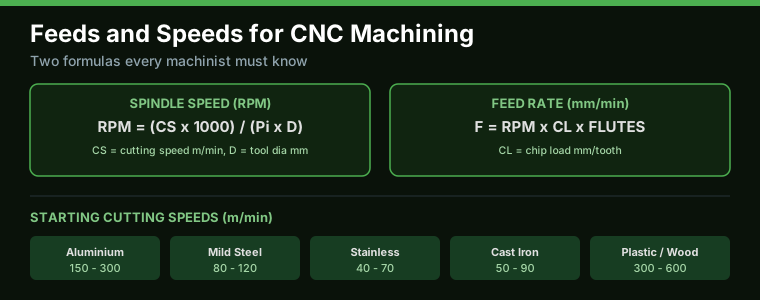
Pro tip: Use a cutting data calculator (many CAM systems include one) to compute optimal speeds and feeds for each tool-material combination rather than relying on generic charts.
6. Common Mistakes That Increase Cycle Time
Even experienced programmers sometimes fall into these traps that silently inflate cycle times:
- Skipping simulation: Simulation catches inefficient toolpath sequences before they hit the machine. Running a simulated time estimate often reveals 10-15% savings opportunities
- Using G0 rapids near rotated parts: In 5-axis, G0 moves near a rotated workpiece force the machine to decelerate for safety anyway — use G01 with 2000mm/min instead for predictable timing
- Passive transforms: Leaving TRAORI or TCP active when not needed adds computational overhead on the control. Cancel transforms when moving between operations
- Incorrect work offsets: Wrong G54 or DWO settings can cause unnecessary repositioning moves that add minutes per cycle
- Over-finishing: Running finish passes over the entire surface when only selected features need tight tolerance — use rest machining to limit finishing to uncut areas
Frequently Asked Questions
How much time can adaptive clearing actually save?
In typical pocketing and roughing operations, switching from conventional to adaptive clearing saves 30-40% in cycle time. On deep cavities with high aspect ratios, savings can exceed 50%.
Is 3+2 machining safer than full 5-axis?
Yes. 3+2 machining is significantly safer because only three axes move during cutting. The risk of head-table collision is eliminated, and tool deflection is more predictable. Most shops use 3+2 for roughing and reserve full 5-axis for finishing complex surfaces.
What CAM systems support rest machining?
Most modern CAM platforms support rest machining: Fusion 360, Mastercam, SolidCAM, Siemens NX, and Autodesk Inventor CAM all have dedicated rest roughing toolpath strategies.
Can I optimize existing programs without changing CAM?
Yes. Adjusting feed rates, enabling look-ahead (G5.1 Q1), adding corner rounding filters, and optimizing retract heights can reduce cycle time by 10-15% without any CAM changes.
Related Reading
Sources
Disclosure: This post contains affiliate links. As an Amazon Associate we earn from qualifying purchases.