Linear Actuators and Linear Motors: Selection for Machine Axes
Key Takeaway
Linear actuators and linear motors are chosen by three numbers: thrust required, moving mass and accuracy needed. Below about 0.02 mm and under 150 N of thrust, a ball screw actuator wins on cost. Above that, or above 2 m/s, a linear motor wins on accuracy and on the absence of a wear part.
Figure 1: Linear actuation: electric actuator versus linear motor – selection and applications
Table of Contents
- 1. Two Answers to the Same Question
- 2. Linear Actuators: The Screw, the Nut and the Limits
- 3. Linear Motors: Removing the Wear Part
- 4. Thrust and the Force Constant
- 5. Moving Mass and the Inertia Problem
- 6. Accuracy and Repeatability
- 7. Heat and the Machine Bed
- 8. Linear Actuators and Linear Motors: Cost and How to Decide
- Related Reading
- Sources
1. Two Answers to the Same Question
A machine axis needs to move a load in a straight line with a known position. There are two families of answer, and the choice between them follows from three numbers: the thrust required, the moving mass, and the accuracy needed.
| Property | Linear actuator (ball screw) | Linear motor |
|---|---|---|
| Output quantity | Thrust, from motor torque | Thrust, direct from current |
| Wear parts | Screw and nut, plus the bearings | Guideway bearings only |
| Backlash | 0.02 to 0.10 mm typical | None |
| Stiffness | Limited by the screw, axial compliance | Very high |
| Typical speed | Up to 1.5 m/s | Up to 8 m/s and beyond |
| Moving mass | Carriage plus screw and nut | Carriage only |
| Heat | Into the screw and the bearings | Into the machine bed, all of it |
| Efficiency | 90 to 95 percent | 95 to 99 percent |
| Cost, 1 m axis | Rs 45,000 to 1,40,000 | Rs 2,80,000 to 9,00,000 |
The actuator is the default because it is cheaper and because it is self-lubricating and needs no power to hold position. The motor wins when the accuracy, the speed or the lifetime requirement is beyond what a screw can deliver.
2. Linear Actuators: The Screw, the Nut and the Limits
How a ball screw actuator is sized
The actuator is the default, and linear actuators and linear motors is really a comparison between the actuator and the motor it replaces. The thrust at the nut comes from the motor torque through the lead:
Working it: 500 N of thrust, a 20 mm lead, a 750 W motor with 3.2 Nm of rated torque and 90 percent efficiency:
T = F x L / (2 x pi x efficiency) = 500 x 0.020 / (6.2832 x 0.90) = 10.0 / 5.6549 = 1.77 Nm
That is a comfortable match to a 3.2 Nm rated motor. Now the same axis with a 5 mm lead, which is a higher-resolution screw:
T = 500 x 0.005 / 5.6549 = 0.442 Nm
Only 0.44 Nm of torque for the same 500 N of thrust, but now the motor runs at four times the speed to deliver the same carriage speed. At 500 mm/s and a 5 mm lead, N = 0.5 / 0.005 = 100 rpm. At 500 mm/s and a 20 mm lead, N = 0.5 / 0.020 = 25 rpm. The fine-pitch screw needs the motor to spin faster, which is usually fine and is sometimes a benefit because it uses the motor’s speed range better.
The screw types
| Type | Lead | Thrust at 1 kW | Efficiency | Use |
|---|---|---|---|---|
| Trapezoidal, 8 to 16 mm lead | Coarse | Low, 1.5 to 3 kN | 25 to 40 percent | Lifts, jacks, slow and strong |
| Ball screw, 10 to 25 mm lead | ||||
| Standard | Medium, 3 to 8 kN | 90 to 95 percent | General machine axes | |
| Ball screw with return nut | Standard | As above | 90 to 95 percent | Backlash free vertical axes |
| Roller screw | Fine, 5 to 15 mm | High, 10 to 40 kN | 90 to 95 percent | High load, high accuracy, long life |
The four limits of an actuator
- Thrust. Limited by the screw diameter and the motor. Beyond about 10 kN, a screw gets expensive and a linear motor is often cheaper.
- Speed. Limited by the screw’s critical speed, which is a function of diameter, length and end support. A long, thin screw whips. The rule is that the screw’s unsupported length should not exceed about 20 times its diameter, and a fixed-fixed support roughly doubles that.
- Life. The rated life of a ball screw is 30,000 to 50,000 km of travel, which on a 500 mm stroke is 60,000 to 100,000 complete cycles. At 10 seconds per cycle and 16 hours a day, that is about 5 years.
- Backlash. A preloaded screw with a return nut gets below 0.01 mm. A plain screw with a clearance fit gets 0.03 to 0.10 mm.
3. Linear Motors: Removing the Wear Part
How it works
The linear motor removes the wear parts entirely, and that is the whole argument for linear actuators and linear motors. A linear motor is an electric motor unrolled. The moving part is a flat coil, called the forcer or the mover, running over a track that carries the field windings in a long slot. Current in the coil and the field in the track produce a force directly, with no screw and no nut in between.
Iron core versus ironless
| Property | Iron core (U channel) | Ironless (flat) |
|---|---|---|
| Force constant | Higher, 40 to 80 N/A | Lower, 15 to 35 N/A |
| Moving mass | Heavier, the iron yoke travels | Very light, the coil only |
| Heat in the moving part | Higher, eddy current heating in the yoke | Lower |
| Peak acceleration | Higher, up to 15 to 20 m/s^2 | Lower, up to 8 to 10 m/s^2 |
| Cost | Higher | Lower per unit of force |
| Typical use | High thrust, general machine axes | High acceleration, small moving mass, clean rooms |
What is actually removed
With a screw drive, the wear parts are the screw, the nut, the nut’s recirculation system and the screw support bearings. A ball screw’s rated life is in kilometres of travel, so it is a consumable with a replacement date. A linear motor has no such part: the only wear items are the guideway bearings and the track’s bearings, both of which are sealed and rated for tens of thousands of hours.
On a machine that runs 24 hours a day with a continuously reciprocating axis, that difference in maintenance planning is worth real money. A packaging machine with three axes at 2 million cycles a year would replace ball screws every three to four years. The same machine on linear motors would replace them never, and would instead need the track cleaned and the bearings checked.
What is not removed
The guideway is still there. A linear motor needs a precision profile rail with a recirculating bearing carriage, and that is the same part a ball screw carriage uses. The guideway bearings are the wear limit in a linear motor axis, and they are rated in kilometres too, usually 20,000 to 30,000 km.
4. Thrust and the Force Constant
where Kf is in newtons per ampere and I is the DC bus current in amps. The force constant is the number that makes linear actuators and linear motors comparable, because it converts current into thrust.
Work it: a linear motor with a force constant of 100 N/A running on a 10 A DC bus produces 1000 N of continuous thrust, and at 20 A it produces 2000 N of peak thrust. The corresponding torque at the motor in an equivalent screw drive: with a 20 mm lead, 1000 N needs T = 1000 x 0.020 / 5.6549 = 3.54 Nm, which is a 750 W motor at 3000 rpm.
The electrical side
The force constant is the number that makes linear actuators and linear motors comparable, because it converts current into thrust. The power to produce the thrust is P = F x v, and the linear motor is a very efficient way to spend it. At 1000 N and 1 m/s the mechanical power is 1000 W. The copper loss in the coil is I^2 x R, so with Kf = 100 N/A and a phase resistance of 2.5 ohm, the loss at 10 A is 100 x 2.5 = 250 W. The efficiency is 1000 / 1250 = 80 percent. That is at the low end because a linear motor has a larger air gap and therefore a lower force constant for a given coil size.
A better motor has a higher force constant and a lower resistance. At Kf = 150 N/A with 1.8 ohm, the loss at 10 A is 180 W and the efficiency is 85 percent.
Comparing with a screw drive
| Quantity | Actuator, 20 mm lead | Linear motor, Kf = 100 N/A |
|---|---|---|
| Continuous thrust | 500 N from a 1.77 Nm motor | 1000 N from 10 A |
| Mechanical power at 0.5 m/s | 250 W | 500 W |
| Drive electronics | Servo drive, 750 W rating | Linear motor drive, 1 kW rating |
| Moving mass | Carriage plus nut, 3 to 8 kg | Forcer only, 1 to 4 kg |
| Total cost, 1 m axis | Rs 1.6 to 2.8 lakh | Rs 5.5 to 12 lakh |
The servo drive for a linear motor
A linear motor needs a servo drive that can drive a single phase or a two-phase coil with high current and low voltage. This is a specific drive type, not a rotary servo drive with a different cable. The drives are 24 V DC or 48 V DC bus, single phase, with currents from 10 A to 100 A. Prices run from about Rs 55,000 for a 5 A unit to Rs 3,50,000 for a 60 A unit.
5. Moving Mass and the Inertia Problem
The acceleration calculation
Moving mass is the term that linear actuators and linear motors handles differently, and it is where a linear motor earns its premium. The force needed to accelerate a mass m at acceleration a is F = m x a. The acceleration possible is limited by the thrust available:
a_max = F_available / m
A 500 mm/s pick-and-place axis with a 15 kg carriage and a ball screw delivering 1000 N of thrust reaches a = 1000 / 15 = 66.7 m/s^2, which is far more than needed. The screw is not the limit. The motor’s torque at the required speed is.
Now a 2 m long transfer axis with a 400 kg carriage and 3000 N of thrust: a = 3000 / 400 = 7.5 m/s^2. That is a good acceleration and it takes 40 ms to reach 0.3 m/s. But the screw has to carry the carriage, and the screw’s own inertia and the nut’s mass add to the reflected inertia at the motor. A 63 mm diameter screw running over 2 m has a mass of roughly 25 kg, and its inertia is substantial.
With a 20 mm lead, that 25 kg screw reflects as J = 25 x (0.020 / 6.2832)^2 = 25 x 1.0133e-5 = 2.53e-4 kg m^2 at the motor. On a 1 kW motor with a rotor inertia of 0.52e-4, that alone is a ratio of 4.87:1 before the carriage is added. The carriage reflects as 400 x 1.0133e-5 = 4.05e-3 kg m^2, giving a total ratio of (4.05e-3 + 2.53e-4) / 0.52e-4 = 82.7:1. That axis cannot be run without a gearbox.
A linear motor removes the screw entirely. The only moving mass is the forcer, and on a 400 kg carriage the forcer itself is 8 to 15 kg. There is no screw to accelerate and no screw inertia at all. The axis becomes a problem the drive can solve.
The energy point
There is a more fundamental reason. Accelerating a 400 kg carriage to 0.3 m/s takes 0.5 x 400 x 0.3^2 = 18 J of kinetic energy. Recovering it on the way down requires a brake resistor or a regenerative drive sized for it. The screw’s inertia adds to the mass that has to be accelerated and decelerated every cycle, and it adds to the energy that has to be dissipated. Removing it removes both.
The precision point
A long screw stretches under load. For a 2 m screw carrying a 400 kg carriage with a stiffness of about 1e9 N/m, the deflection is F x L / (E x A) with the screw as a column. Even in a well-designed machine, the axial deflection of a long screw under load is in the range of 0.02 to 0.05 mm, and it changes with the load. A linear motor has no such deflection; the moving mass rides on the guideway and the position is measured at the mover.
6. Accuracy and Repeatability
| Property | Ball screw | Linear motor with scale | Linear motor without scale |
|---|---|---|---|
| Positioning accuracy | 0.01 to 0.05 mm | 1 to 5 microns | 10 to 50 microns |
| Repeatability | 0.005 to 0.02 mm | Under 1 micron | 5 to 20 microns |
| Lost motion | 0.01 to 0.10 mm | None | None |
| Thermal growth over 500 mm | 5 to 20 microns | 5 to 20 microns, unless the scale is thermally matched | Same |
The scale matters more than the motor
Accuracy is the second axis of comparison in linear actuators and linear motors, and it is the one that decides most precision applications. A linear motor without a linear scale is a closed loop on the mover’s position, which leaves the gap between the mover and the load unmeasured. On a short, stiff axis that is fine. On a long axis where the guideway and the frame flex, the mover’s position is not the load’s position, and the difference is the flex. Adding a linear scale closes that loop and the axis accuracy improves by an order of magnitude.
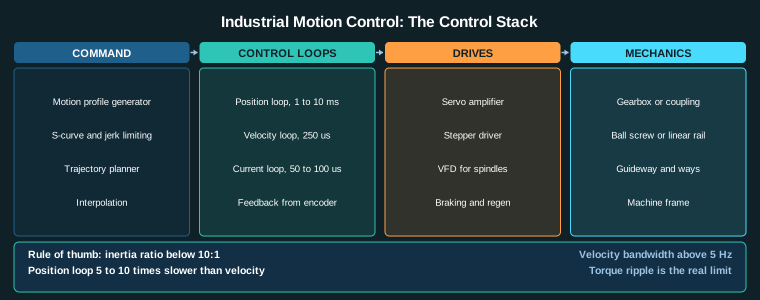
An optical glass scale for a 500 mm axis costs about Rs 35,000 to Rs 90,000 in India. The scale must be mounted on the same structure as the load and thermally matched to it, or it will read its own bracket’s error. The industrial motion control guide covers the feedback device decision in full.
Thermal effects
Every linear axis grows with heat. Cast iron has a coefficient of thermal expansion of about 11 ppm per degree C. Over a 500 mm stroke, a 20 degree C rise produces 500 x 11e-6 x 20 = 0.11 mm of growth. On a screw drive, the screw grows at about 11 ppm too and the nut is usually at a different temperature, so the error shows up. On a linear motor with a scale, the scale and the structure must be mounted so they grow together, which is a mounting discipline rather than a specification.
On a machine where the accuracy requirement is a few microns, the thermal budget is the dominant error source and it is the hardest to control. A spindle that runs hot above the axis is the classic cause.
7. Heat and the Machine Bed
Where the heat goes with an actuator
With a ball screw, roughly 60 to 70 percent of the motor’s losses go into the screw, the nut and the bearings. A 750 W motor at 60 percent moving efficiency dissipates 500 W of loss, and about 350 W of that ends up in the screw, conducted along its length into the ball nut and the bearing housings, and out into the machine bed. Heat is the practical difference between linear actuators and linear motors that the datasheets do not make obvious.
Where the heat goes with a linear motor
Heat is the practical difference between linear actuators and linear motors that the datasheets do not make obvious. A linear motor puts essentially all of its loss into the track, which is bolted to the machine bed. At 1000 N and 0.5 m/s, the mechanical power is 500 W and the loss at 85 percent efficiency is about 88 W. The heat goes into the track and into the machine structure, which is a thermal problem for the machine designer rather than for the axis.
That sounds like an advantage and it is, with one qualification: the track has no self-convection path. It is a long aluminium or steel extrusion bolted flat to a casting, and it conducts heat into the casting rather than into the air. In a machine where the accuracy is measured in microns, the casting warming up near the scale is a bigger problem than the screw’s heat was, because the screw’s heat went into the nut and away from the measurement.
Iron core versus ironless again
The iron core motor has eddy current heating in its moving iron yoke, which adds to the moving mass and to the heat. The ironless motor has no iron in the moving part, so the moving mass and the moving heat are both lower. That is why an ironless motor is the choice in a clean room or on a semiconductor inspection stage, and why an iron-core motor is the choice for a press or a stamping feed where the thrust matters more than the mass.
5. Moving Mass and the Inertia Problem
The acceleration calculation
Moving mass is the term that linear actuators and linear motors handles differently, and it is where a linear motor earns its premium. The force needed to accelerate a mass m at acceleration a is F = m x a. The acceleration possible is limited by the thrust available:
a_max = F_available / m
A 500 mm/s pick-and-place axis with a 15 kg carriage and a ball screw delivering 1000 N of thrust reaches a = 1000 / 15 = 66.7 m/s^2, which is far more than needed. The screw is not the limit. The motor’s torque at the required speed is.
Now a 2 m long transfer axis with a 400 kg carriage and 3000 N of thrust: a = 3000 / 400 = 7.5 m/s^2. That is a good acceleration and it takes 40 ms to reach 0.3 m/s. But the screw has to carry the carriage, and the screw’s own inertia and the nut’s mass add to the reflected inertia at the motor. A 63 mm diameter screw running over 2 m has a mass of roughly 25 kg, and its inertia is substantial.
With a 20 mm lead, that 25 kg screw reflects as J = 25 x (0.020 / 6.2832)^2 = 25 x 1.0133e-5 = 2.53e-4 kg m^2 at the motor. On a 1 kW motor with a rotor inertia of 0.52e-4, that alone is a ratio of 4.87:1 before the carriage is added. The carriage reflects as 400 x 1.0133e-5 = 4.05e-3 kg m^2, giving a total ratio of (4.05e-3 + 2.53e-4) / 0.52e-4 = 82.7:1. That axis cannot be run without a gearbox.
A linear motor removes the screw entirely. The only moving mass is the forcer, and on a 400 kg carriage the forcer itself is 8 to 15 kg. There is no screw to accelerate and no screw inertia at all. The axis becomes a problem the drive can solve.
The energy point
There is a more fundamental reason. Accelerating a 400 kg carriage to 0.3 m/s takes 0.5 x 400 x 0.3^2 = 18 J of kinetic energy. Recovering it on the way down requires a brake resistor or a regenerative drive sized for it. The screw’s inertia adds to the mass that has to be accelerated and decelerated every cycle, and it adds to the energy that has to be dissipated. Removing it removes both.
The precision point
A long screw stretches under load. For a 2 m screw carrying a 400 kg carriage with a stiffness of about 1e9 N/m, the deflection is F x L / (E x A) with the screw as a column. Even in a well-designed machine, the axial deflection of a long screw under load is in the range of 0.02 to 0.05 mm, and it changes with the load. A linear motor has no such deflection; the moving mass rides on the guideway and the position is measured at the mover.
6. Accuracy and Repeatability
| Property | Ball screw | Linear motor with scale | Linear motor without scale |
|---|---|---|---|
| Positioning accuracy | 0.01 to 0.05 mm | 1 to 5 microns | 10 to 50 microns |
| Repeatability | 0.005 to 0.02 mm | Under 1 micron | 5 to 20 microns |
| Lost motion | 0.01 to 0.10 mm | None | None |
| Thermal growth over 500 mm | 5 to 20 microns | 5 to 20 microns, unless the scale is thermally matched | Same |
The scale matters more than the motor
Accuracy is the second axis of comparison in linear actuators and linear motors, and it is the one that decides most precision applications. A linear motor without a linear scale is a closed loop on the mover’s position, which leaves the gap between the mover and the load unmeasured. On a short, stiff axis that is fine. On a long axis where the guideway and the frame flex, the mover’s position is not the load’s position, and the difference is the flex. Adding a linear scale closes that loop and the axis accuracy improves by an order of magnitude.
An optical glass scale for a 500 mm axis costs about Rs 35,000 to Rs 90,000 in India. The scale must be mounted on the same structure as the load and thermally matched to it, or it will read its own bracket’s error. The industrial motion control guide covers the feedback device decision in full.
Thermal effects
Every linear axis grows with heat. Cast iron has a coefficient of thermal expansion of about 11 ppm per degree C. Over a 500 mm stroke, a 20 degree C rise produces 500 x 11e-6 x 20 = 0.11 mm of growth. On a screw drive, the screw grows at about 11 ppm too and the nut is usually at a different temperature, so the error shows up. On a linear motor with a scale, the scale and the structure must be mounted so they grow together, which is a mounting discipline rather than a specification.
On a machine where the accuracy requirement is a few microns, the thermal budget is the dominant error source and it is the hardest to control. A spindle that runs hot above the axis is the classic cause.
7. Heat and the Machine Bed
Where the heat goes with an actuator
With a ball screw, roughly 60 to 70 percent of the motor’s losses go into the screw, the nut and the bearings. A 750 W motor at 60 percent moving efficiency dissipates 500 W of loss, and about 350 W of that ends up in the screw, conducted along its length into the ball nut and the bearing housings, and out into the machine bed. Heat is the practical difference between linear actuators and linear motors that the datasheets do not make obvious.
Where the heat goes with a linear motor
Heat is the practical difference between linear actuators and linear motors that the datasheets do not make obvious. A linear motor puts essentially all of its loss into the track, which is bolted to the machine bed. At 1000 N and 0.5 m/s, the mechanical power is 500 W and the loss at 85 percent efficiency is about 88 W. The heat goes into the track and into the machine structure, which is a thermal problem for the machine designer rather than for the axis.
That sounds like an advantage and it is, with one qualification: the track has no self-convection path. It is a long aluminium or steel extrusion bolted flat to a casting, and it conducts heat into the casting rather than into the air. In a machine where the accuracy is measured in microns, the casting warming up near the scale is a bigger problem than the screw’s heat was, because the screw’s heat went into the nut and away from the measurement.
Iron core versus ironless again
The iron core motor has eddy current heating in its moving iron yoke, which adds to the moving mass and to the heat. The ironless motor has no iron in the moving part, so the moving mass and the moving heat are both lower. That is why an ironless motor is the choice in a clean room or on a semiconductor inspection stage, and why an iron-core motor is the choice for a press or a stamping feed where the thrust matters more than the mass.
8. Linear Actuators and Linear Motors: Cost and How to Decide
| Item | Actuator version | Linear motor version |
|---|---|---|
| Motor | 750 W servo, Rs 22,000 to 42,000 | 1 kW linear motor, Rs 1,20,000 to 2,80,000 |
| Drive | 750 W servo drive, Rs 65,000 to 1,10,000 | 1 kW linear motor drive, Rs 1,10,000 to 1,90,000 |
| Transmission | 63 mm ball screw, 2 m, Rs 65,000 to 1,20,000 | Not needed |
| Guideway, 2 m | Rs 45,000 to 85,000 | Rs 70,000 to 1,30,000 |
| Linear scale, optional | Rs 40,000 to 95,000 | Rs 40,000 to 95,000 |
| Total, 2 m axis | Rs 2,40,000 to 4,50,000 | Rs 4,00,000 to 8,00,000 |
The decision rule
- Use an actuator
when the thrust is below about 1500 N, the accuracy requirement is looser than 0.02 mm, the speed is below 1 m/s, and the axis does not run continuously.
Putting linear actuators and linear motors side by side with Indian prices gives the decision a number attached to it. The actuator route is also the one that fits most Indian workshops, because the parts are available locally, the repair is a nut and a bearing, and the drive is a standard servo drive that a technician already knows. The linear motor route is the right answer for a machine whose downtime cost justifies it.
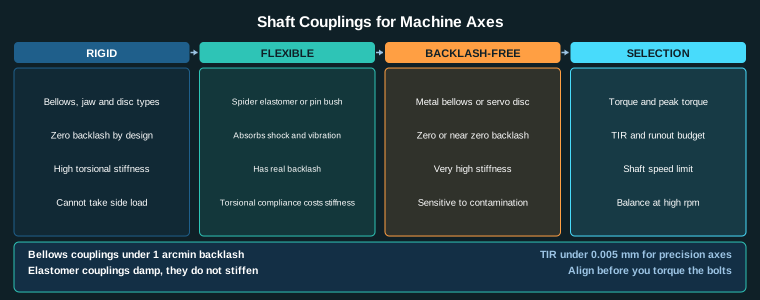
The related topic of the drive and its power budget is in the servo drive selection guide, and the drive train between the motor and the load is in the shaft coupling guide.
Related Reading
- Industrial Motion Control: Complete Guide to Servo, Stepper and Axis Design
- Servo Drive Selection and Sizing: Power, Regeneration and Cable
- Harmonic Drive Gearbox Selection: Ratio, Repeatability and Life
- Shaft Couplings for Machine Axes: Rigid, Flexible and Backlash-Free
Sources
- IKO Linear Way, Linear Motion Guide and Linear Motor Technical Reference (force constant, accuracy)
- Thomson, Linear Actuator and Ball Screw Selection Guide (life, thrust, efficiency)
- Bosch Rexroth, Linear Motion Technology Catalogue (iron-core and ironless motors)
- HIWIN, Linear Actuator and Linear Motor Product Catalogue
- ISO 9283, Machine tools: Test conditions for positioning accuracy and repeatability
Key Takeaways
- Linear actuators and linear motors are compared on thrust: a linear motor converts force directly, so its rating is thrust. A 100 N linear motor with a force constant of 100 N per amp produces 100 N of continuous thrust at 1 A of DC bus current.
- A ball screw actuator converts torque into thrust, so the same axis needs a motor sized for thrust times 2 pi divided by the lead. With a 20 mm lead, 500 N of thrust needs 157 Nm at the screw.
- Actuator thrust needed at the nut is load force plus friction plus the inertia term. The inertia term is mass times acceleration, and at 5 m/s^2 with a 60 kg carriage it is 300 N on its own.
- Backlash and wear are the two reasons to move to a linear motor. Actuator life of 30,000 to 50,000 km is typical, and it is consumed by running hours, not by cycles.
- Linear motors push their heat into the machine. A 100 N motor at 100 N/A dissipates I squared times R, and that heat has to leave the machine bed.