
Key Takeaway: For industrial automation applications, STM32 microcontrollers offer superior performance, memory, and peripheral support compared to Arduino, making them the preferred choice for production systems — but Arduino remains excellent for prototyping and educational purposes.
Table of Contents
1. Platform Overview
When designing embedded systems for industrial applications, one of the first decisions engineers face is choosing the right microcontroller platform. The STM32 vs Arduino debate has been ongoing in the maker and engineering communities for years, but for industrial automation the choice becomes much clearer once you examine the technical specifications and real-world requirements.
Arduino, built around 8-bit AVR microcontrollers from Microchip (formerly Atmel), was designed as an educational platform. Its simplicity and vast community support make it incredibly accessible. The Arduino Uno, which uses the ATmega328P, and the Arduino Nano are the most popular boards for hobbyist projects and rapid prototyping.
STM32, on the other hand, is a family of 32-bit ARM Cortex-M microcontrollers from STMicroelectronics. With options ranging from entry-level Cortex-M0 chips to high-performance Cortex-M7 processors, STM32 covers a vast range of industrial and commercial applications. Boards like the STM32F4 Discovery, NUCLEO-F446RE, and the popular Blue Pill (STM32F103C8) offer a gateway into professional-grade embedded development.
The fundamental difference lies in their target applications: Arduino excels at getting beginners started with electronics quickly, while STM32 is designed for engineers who need real-time performance, extensive peripheral integration, and industrial-grade reliability.
2. Performance & Architecture Comparison
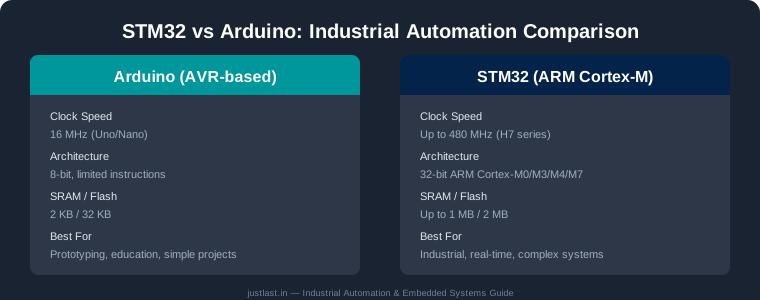
The performance gap between Arduino and STM32 is substantial. Arduino Uno runs at 16 MHz with an 8-bit architecture, meaning it processes data one byte at a time. This is adequate for simple sensor readings, LED control, and basic motor control, but becomes a bottleneck in applications requiring real-time data processing, communication protocol handling, or complex control algorithms.
STM32 microcontrollers operate at clock speeds ranging from 48 MHz on entry-level models up to 480 MHz on the high-end STM32H7 series. The 32-bit ARM Cortex-M architecture processes four bytes per instruction cycle, resulting in significantly higher throughput. For industrial automation tasks like PID control loops, encoder feedback processing, and multi-axis motion control, this performance is essential.
The Cortex-M4 and Cortex-M7 cores include DSP (Digital Signal Processing) instructions and floating-point units (FPU). This means STM32 can handle real-time signal processing for applications like vibration analysis, motor current monitoring, and sensor fusion without external DSP chips. Arduino’s 8-bit AVR architecture lacks these capabilities entirely.
3. Memory & Storage Capabilities
Memory limitations are often the deciding factor in the STM32 vs Arduino choice for industrial projects. Arduino Uno offers just 2 KB of SRAM and 32 KB of flash storage. Once you add libraries for communication protocols, sensor drivers, and application logic, this space fills up quickly. Complex projects often require aggressive optimization or simply cannot fit.
STM32 devices start at 8 KB SRAM / 64 KB flash on the low end and scale to 1 MB SRAM / 2 MB flash on high-end models. The STM32F103C8 (Blue Pill), which costs around $3-5, offers 20 KB SRAM and 64 KB flash — already a significant upgrade. The STM32F446RE on the NUCLEO board provides 128 KB SRAM and 512 KB flash. This headroom allows for richer application code, larger data buffers, and over-the-air (OTA) update capabilities.
For industrial systems that need to log operational data, run communication stacks (EtherCAT, CANopen, Modbus TCP), or implement safety monitoring, the extra memory on STM32 is not a luxury but a necessity.
4. Peripherals & Industrial I/O
Industrial automation requires diverse communication interfaces. Arduino Uno provides one UART (serial), one I2C bus, and one SPI bus — sufficient for connecting a few sensors but quickly exhausted in complex systems.
STM32 chips offer multiple instances of each peripheral: 3-8 UARTs, 3-6 I2C buses, 3-6 SPI buses, multiple CAN 2.0B/FD controllers, USB OTG, Ethernet MAC, SDIO, and advanced timers with hardware PWM generation. For motion control applications, STM32’s advanced timers can generate complex PWM signals with dead-time insertion, essential for driving MOSFET-based H-bridges and servo drives.
The integrated CAN controller on most STM32 devices is particularly valuable for industrial automation. CAN bus is the backbone of industrial communication, used in everything from conveyor systems to CNC machines. Adding CAN to Arduino requires an external MCP2515 controller and CAN transceiver, adding cost and complexity.
5. Development Ecosystem & Tools
Arduino’s ecosystem is its strongest advantage. The Arduino IDE is straightforward, libraries are abundant, and the community is enormous. A beginner can have an LED blinking within five minutes of opening the box. This rapid prototyping capability is valuable for proof-of-concept work.
STM32 development has historically been more complex, but STM32CubeIDE has dramatically improved the experience. STM32CubeMX provides a graphical pin configuration and code generation tool that initializes peripherals, clocks, and DMA configurations automatically. The HAL (Hardware Abstraction Layer) and LL (Low-Layer) APIs provide both ease of use and performance optimization paths.
For production environments, STM32’s toolchain supports professional debugging via SWD (Serial Wire Debug) with breakpoints, watchpoints, and real-time variable tracking. The ST-Link debugger, included on most STM32 development boards, provides this capability at no extra cost. Arduino’s debugging is limited to serial print statements, which is impractical for complex industrial debugging.
6. Cost Analysis for Production
At first glance, Arduino boards appear cheaper — an Arduino Nano clone costs around $3-5. However, for production, you would not use a complete Arduino board. You would use the bare ATmega328P chip, which costs approximately $2-3 in single-unit quantities.
STM32 chips like the STM32F103C8 cost $2-4, and the STM32G030 (Cortex-M0+) costs under $1 in volume. Considering the vastly superior specifications, the STM32 offers significantly better value for industrial applications. When you factor in the reduced need for external components (CAN controllers, additional UART chips, external ADCs), the total system cost often favors STM32.
For prototyping and low-volume production runs (under 100 units), Arduino remains cost-effective. For any production run where reliability, performance, and connectivity matter, STM32 is the better economic choice.
7. Which One Should You Choose?
Choose Arduino when:
- Building a quick prototype or proof of concept
- Teaching electronics and programming fundamentals
- Creating simple standalone projects with minimal I/O requirements
- Running on battery power where 8-bit efficiency matters
- Volume is very low and development speed is the priority
Choose STM32 when:
- Developing products for industrial or commercial deployment
- Real-time control loops (motor control, PID, robotics)
- Multiple communication protocols needed (CAN, Ethernet, multiple UARTs)
- Complex sensor fusion or signal processing required
- Production volumes above 100 units
- Long-term reliability and professional debugging needed
Frequently Asked Questions
Can Arduino be used for industrial automation?
Arduino can be used for simple industrial automation tasks like basic sensor monitoring or controlling a single relay, but it lacks the performance, memory, and industrial communication interfaces (CAN, EtherCAT) required for most industrial applications.
Is STM32 difficult to program compared to Arduino?
STM32 has a steeper initial learning curve, but STM32CubeIDE and the HAL libraries make it much more accessible than in the past. Once you understand the GPIO, timer, and interrupt concepts, the transition from Arduino to STM32 is straightforward.
What is the cheapest STM32 board for beginners?
The STM32F103C8 “Blue Pill” board, available for $3-5, is the most affordable entry point. For a better development experience, the NUCLEO-F446RE ($15-20) includes an integrated ST-Link debugger.
Can STM32 run Arduino code?
Not directly, but the STM32duino project (STM32 core for Arduino IDE) allows you to program many STM32 devices using the Arduino framework. This provides a migration path from Arduino to STM32 while reusing some code structure.
Related Reading
- Getting Started with STM32 Programming: Complete Guide for Industrial Applications
- More Industrial Automation Guides at justLast.in
Sources
- STMicroelectronics – STM32 32-bit ARM Cortex MCUs
- Arduino Official Documentation
- DigiKey – STM32 vs Arduino Comparison
- ARM Cortex-M4 Processor Overview
Disclosure: This post contains affiliate links. We may earn a commission on qualifying purchases at no additional cost to you.