
Key Takeaway: For most CNC and 3D-printing builds the DRV8825 is the best-value stepper motor driver because it handles higher current with 1/32 microstepping, while the TMC2209 wins when you need silent operation, sensorless homing, and cooler running — and the A4988 remains the budget entry point.
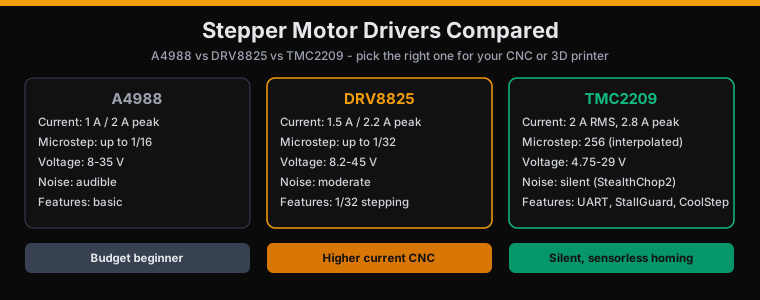
Table of Contents
- 1. Why the Driver Matters as Much as the Motor
- 2. Specification Comparison: A4988 vs DRV8825 vs TMC2209
- 3. Current Handling and Vref Setting
- 4. Microstepping and Motion Quality
- 5. Noise, Efficiency, and Smart Features
- 6. Pin Compatibility and Swapping Drivers
- 7. Which Stepper Motor Driver Should You Buy?
- 8. FAQ
- 9. Related Reading
- 10. Sources
1. Why the Driver Matters as Much as the Motor
Your stepper motor driver decides how much torque your NEMA motor can deliver, how quietly it runs, how smoothly it moves, and whether your board overheats. The three most common STEP/DIR drivers on the market — the Allegro A4988, the Texas Instruments DRV8825, and the Trinamic TMC2209 — are pin-compatible on the standard Pololu-style breakout footprint, yet they behave very differently under load. Choosing the wrong stepper motor driver is one of the most common reasons a CNC router loses steps or a 3D printer sounds like a jackhammer.
All three use a step and direction interface: your controller sends a pulse on STEP to move one microstep and a level on DIR to pick the direction. The driver handles the coil sequencing, current limiting, and microstepping internally. What separates them is current capacity, resolution, and the chopper technology underneath.
2. Specification Comparison: A4988 vs DRV8825 vs TMC2209
The headline numbers are easy to find but easy to misread. Current ratings are usually quoted per coil, and continuous versus peak matters. Here is the practical summary:
- A4988: 1 A continuous, 2 A peak per coil; 8–35 V motor supply; microstepping up to 1/16; about $1–2 per module.
- DRV8825: 1.5 A continuous, 2.2 A peak per coil; 8.2–45 V motor supply; microstepping up to 1/32; slightly higher price than the A4988.
- TMC2209: 2 A RMS (2.8 A peak) coil current; 4.75–29 V supply; native STEP/DIR with 8/16/32/64 microstep pins plus 256 microstep interpolation via MicroPlyer; adds StealthChop2, SpreadCycle, StallGuard4, and CoolStep.
The DRV8825’s 45 V ceiling is significant: a 24 V supply is the sweet spot for desktop CNC because higher voltage lets current rise faster in the coils, preserving torque at higher RPM. The TMC2209 runs on lower voltage but compensates with a far more efficient chopper.
3. Current Handling and Vref Setting
Every driver uses a trimpot to set the current limit, but the formula differs — and mixing them up burns motors. The sense-resistor formulas are:
- A4988: Vref = I_max x 8 x Rsense (with 0.1 ohm sense, Vref = I_max x 0.8).
- DRV8825: Vref = I_max x 5 x Rsense (with 0.1 ohm sense, Vref = I_max x 0.5).
- TMC2209: Vref = I_max x 2.5 V / 1.77 A, roughly Vref = I_max x 1.41.
If you swap an A4988 for a DRV8825 without re-setting the trimpot, you can drive the motor far past its rating — the classic 1.5 A motor suddenly sees the equivalent of roughly 2.4 A and overheats. Always leave 10–20 percent headroom below the motor’s rated current and measure Vref with a multimeter while the driver is powered. For a NEMA 17 rated at 1.2 A, set the driver just under that value.
4. Microstepping and Motion Quality
Microstepping divides each full step into smaller increments for smoother motion and reduced resonance. On a standard 1.8-degree NEMA 17 (200 full steps per revolution):
- A4988 at 1/16 gives 3,200 microsteps per revolution, or 0.1125 degrees per microstep.
- DRV8825 at 1/32 gives 6,400 microsteps per revolution, or 0.05625 degrees per microstep — about 1.25 microns per microstep on an 8 mm-per-revolution leadscrew.
- TMC2209 accepts 1/16 to 1/64 from the STEP input and internally interpolates to 256 microsteps with MicroPlyer for buttery-smooth motion.
For camera sliders, lab equipment, or precision CNC where vibration affects results, finer microstepping measurably improves quality. For most 3D printing, 1/16 is already enough.
5. Noise, Efficiency, and Smart Features
This is where the TMC2209 separates itself. Its StealthChop2 chopper makes the motor effectively inaudible at standstill and low speed, which matters in offices, labs, and medical equipment. SpreadCycle mode handles high-velocity, high-dynamics motion. StallGuard4 measures mechanical load on the motor through the back-EMF, enabling sensorless homing — the axis finds its endstop without a physical switch. CoolStep dynamically reduces motor current when load is light, cutting energy use by up to 75 percent and keeping both motor and driver cool.
The A4988 and DRV8825 use simpler choppers. In full-step mode both vibrate and whine audibly; higher microstepping smooths them out. The DRV8825’s lower RDS(on) MOSFET outputs run slightly cooler than the A4988’s at the same current, but both need a heatsink above roughly 1 A continuous.
6. Pin Compatibility and Swapping Drivers
All three drivers are drop-in compatible on RAMPS 1.4, Arduino CNC shields, and most custom PCBs — same footprint, same STEP/DIR interface. The one physical gotcha: the DRV8825’s trimpot sits on the opposite end from the A4988, so check the EN pin marking rather than the pot when orienting the board.
There are two electrical gotchas when swapping. First, recalibrate Vref (Section 3). Second, the minimum STEP pulse differs: the A4988 accepts 1 us pulses, while the DRV8825 requires 1.9 us. At very high step rates in optimized firmware this can cause missed steps on the DRV8825. The TMC2209 adds a UART interface (single-wire, on the PDN_UART pin) for configuring current, microstepping, and features in software — and its pinout is compatible with both A4988 and DRV8825 carriers.
7. Which Stepper Motor Driver Should You Buy?
Choose the A4988 if: you are a beginner, your motor is rated 1.2 A or less, you run a 12 V supply, and your budget is tight. It is cheap, everywhere, and more than adequate for standard 3D printing.
Choose the DRV8825 if: your motor is rated 1.5 A or above, you run a 24 V system for higher-speed CNC, you want 1/32 microstepping, or you are building a serious CNC machine. It is the best value stepper motor driver for most desktop CNC work.
Choose the TMC2209 if: you need silent operation, sensorless homing, the lowest heat and power draw, or UART-configurable current and microstepping. It costs more but is the modern standard for premium 3D printers and precision equipment.
For heavier NEMA 23 or NEMA 34 motors, none of these boards suffice — step up to a TB6600 or DM542 external driver. And if you are still deciding between motor types, read our stepper vs servo motor guide before committing. Once your driver is chosen, our PID motor control guide shows how to close the loop around it.
Frequently Asked Questions
Is DRV8825 better than A4988?
For most builds, yes. The DRV8825 handles more current (1.5 A continuous vs 1 A), supports 1/32 vs 1/16 microstepping, and accepts up to 45 V motor supply. It is the better choice for 24 V systems and heavier NEMA 17 motors.
Can I replace A4988 with TMC2209?
Yes. The TMC2209 is pin-compatible with the A4988 footprint and adds silent StealthChop2 operation, sensorless homing, and UART configuration. Just wire the PDN_UART pin and re-set the current limit.
How do I set stepper driver current?
Turn the trimpot while measuring Vref on the driver’s reference-voltage test point, then convert using the driver’s formula: A4988 Vref = I x 0.8, DRV8825 Vref = I x 0.5, TMC2209 Vref = I x 1.41 (approximate, with 0.1 ohm sense resistors). Always set current below the motor’s rated value.
Why is my stepper motor so loud?
Full-step operation, a basic chopper, or the wrong microstep setting causes audible noise. Switch to a higher microstep resolution, or use a TMC2209 in StealthChop2 mode for silent operation.
What is the difference between continuous and peak current?
Continuous current is what the driver sustains over time; peak is the short burst rating. For example, the DRV8825 is rated 1.5 A continuous and 2.2 A peak. Size your motor and heatsink for the continuous figure.
Related Reading
- Stepper vs Servo Motors for CNC: Complete Selection Guide
- PID Motor Control with Arduino and STM32
- Feeds and Speeds for CNC Machining
- CNC Lathe Programming with G-code
Sources
- Texas Instruments DRV8825 Datasheet
- Trinamic (Analog Devices) TMC2209 Datasheet
- Pololu A4988 Stepper Motor Driver Carrier
- How to Set Stepper Driver Current — Circuitist
- DRV8825 vs A4988: Which Stepper Driver Should You Buy? — Zbotic
Disclosure: This post contains affiliate links. As an Amazon Associate and partner of electronics distributors, justlast.in may earn a commission on qualifying purchases at no extra cost to you.