
Key Takeaway: Stepper motors are the right choice for most hobby and light-production CNC machines because they are cheap, simple, and hold position in open loop, while servo motors justify their higher cost only when you need high-speed machining, heavy cutting, or guaranteed no-loss positioning — so match the motor to the cutting load, not the brand.
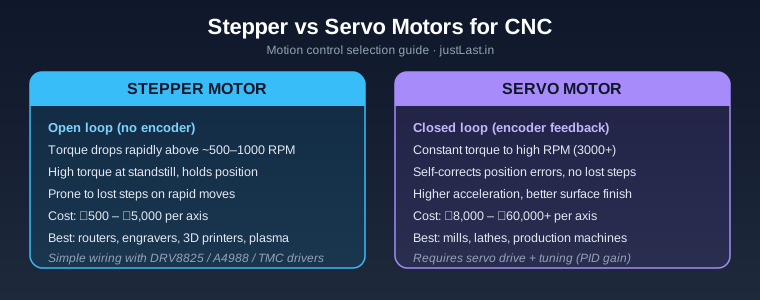
Table of Contents
1. How Stepper and Servo Motors Differ
The stepper vs servo motors for cnc decision shapes the performance, cost, and reliability of every axis on your machine. Both convert electrical pulses into rotary motion, but they do it in fundamentally different ways. A stepper motor rotates in fixed angular steps — typically 200 full steps per revolution — and it is driven by a stepper driver that simply sends current through its coils in sequence. The controller always assumes the motor is where it should be, because there is no feedback telling it otherwise.
A servo motor is a DC or AC motor paired with an encoder and a servo drive. The encoder constantly reports the rotor’s actual position back to the drive, which compares it with the commanded position and corrects the error every few hundred microseconds. That feedback loop is the entire difference: a stepper is an open-loop device, a servo is a closed-loop device.
This is not a question of one being “better” — they are different tools. A stepper excels at low-speed precision and holding torque; a servo excels at speed and sustained torque. Your choice must reflect the forces your machine actually generates while cutting.
2. Torque and Speed Characteristics
Look at a torque curve and the picture becomes clear. A stepper motor produces its highest torque at standstill and at very low speed, then the torque falls off sharply as speed increases. A typical NEMA 23 stepper holds a lot of torque at zero RPM but may lose 80% of it by 1,000 RPM. This is because the inductance of the motor coils limits how fast the current can be switched.
A servo motor behaves completely differently. Its torque is relatively flat across its speed range, right up to 3,000 or 4,000 RPM, because the drive continuously adjusts current to maintain the commanded motion. This is why production machines use servos: they can cut aluminium at rapid feed rates without stalling, and they can do finishing passes at high surface speeds.
For a router cutting wood or a small engraver, the stepper’s high low-speed torque is perfect, because those jobs rarely exceed 1,000-1,500 mm/min on the axes. For a mill hogging steel, the servo’s flat torque curve is non-negotiable. If you are converting a machine or building one, the drive-train decision is as important as the spindle — a topic we covered in detail in our DRV8825 stepper driver guide.
3. Open Loop vs Closed Loop
The open-loop behaviour of a stepper has a famous failure mode: lost steps. If the cutting load exceeds the motor’s available torque, the rotor slips and stops tracking the pulse train, and the controller has no way to know. The result is a ruined part that looks perfectly fine in the CAM simulation. This usually happens during aggressive cuts, rapid acceleration, or when the machine binds on a worn leadscrew nut.
Servos eliminate this class of failure because the encoder detects the position error instantly and the drive either corrects it or alarms out. The trade-off is complexity: a servo system must be tuned. Setting the PID gains wrong produces the exact symptoms this guide’s companion article on PID motor control describes — oscillation, overshoot, and steady-state error.
There is also a middle option. Closed-loop steppers (also called servo steppers or hybrid steppers) add an encoder to a stepper motor and use a driver that monitors position without a full servo tuning procedure. They keep the simplicity of a stepper but detect and correct lost steps automatically. For retrofit machines this is often the best value upgrade available.
4. Which CNC Machines Use Which Motor
Look at the machine market and the pattern is consistent. Desktop routers, laser engravers, 3D printers, and hobby CNC machines almost all use stepper motors because they are inexpensive, require only a driver board, and are accurate enough for these applications. Our GRBL CNC setup guide is built on exactly this type of system — an Arduino running GRBL, four steppers, and simple driver boards.
Professional vertical machining centres, production lathes, and high-speed routers use AC servo motors. These machines cut continuously under load, need 3,000+ RPM axis travel, and cannot afford lost steps on expensive stock. Between the two sits a growing market of closed-loop steppers used in prosumer mills and light production machines where users want servo-like reliability without servo pricing.
The machine type also dictates motor size. A 6040 router typically uses NEMA 23 steppers; a large 1325 production router may use NEMA 34 steppers or 750 W-1 kW servos; a VMC uses 1-3 kW servos per axis. Matching the motor frame size to the machine’s mass is essential — undersized motors stall, oversized motors waste money.
5. Cost, Wiring, and Tuning
Price is a decisive factor for Indian workshops. A NEMA 23 stepper plus a cheap driver costs around ₹500-₹1,500 per axis, and an Arduino/GRBL controller ties the whole machine together for a few thousand rupees. A basic closed-loop stepper kit runs ₹3,000-₹6,000 per axis. A genuine AC servo kit (motor, drive, and cables) starts around ₹8,000-₹15,000 per axis and rises steeply for bigger motors.
Wiring reflects the same gap. A stepper needs four motor wires and four signal wires; a servo needs a power cable, an encoder cable, a signal cable, and careful shielding. Servo drives also need a DC bus supply, often 48 V to 80 V, sized for the peak current of all axes. Stepper drivers run happily on a single 24 V or 36 V supply.
Tuning is where most servo conversions fail. Every servo axis needs PID gain settings that match the machine’s inertia and rigidity. A stiff machine allows high gains; a flexing frame cannot. Get the gains wrong and the axis either squeals, oscillates, or runs dangerously slow. Steppers need no tuning at all — another reason they remain the default for first machines.
6. Hybrid Options and the Middle Ground
The old stepper-or-servo binary has blurred. Closed-loop stepper systems now combine a stepper motor, an encoder, and a driver that closes the loop at the driver level. They detect lost steps and add corrective pulses, giving you the peace of mind of a servo with the wiring simplicity of a stepper. They are not as fast as true servos at high RPM, but for routers and light mills they close most of the gap.
There are also geared and planetary steppers for low-speed high-torque applications, and linear motors for ultra-high-speed machines that need no rotary-to-linear conversion at all. For a workshop owner, the practical upgrade path is: start with steppers, and if lost steps or speed become the bottleneck, move to closed-loop steppers before jumping to full servos.
7. How to Decide for Your Machine
Work through these four questions:
- What is the maximum axis feed rate you need? Below 2,000 mm/min, a stepper is usually fine; above that, look at closed-loop or servo.
- What materials do you cut? Wood, plastic, and light aluminium favour steppers; steel and production work favour servos.
- Can you afford a lost step? If a scrapped part costs more than a servo system, buy the servo.
- Who will maintain it? Servo tuning needs skill; steppers are nearly maintenance-free.
For most Indian workshops starting out, the answer is a NEMA 23 or NEMA 34 stepper with decent drivers and a solid power supply. If your machine is a production asset cutting metal all day, budget for servos. The decision also interacts with the machine type itself — a router versus mill comparison shows that machine rigidity, not just the motor, sets the practical ceiling for accuracy and speed.
Frequently Asked Questions
Are servo motors worth the extra cost for CNC?
Yes, if you machine metal at high feed rates or cannot afford lost steps on expensive workpieces. Servos maintain torque at high RPM, correct position errors automatically, and alarm instead of silently mis-positioning. For a hobby router, the extra cost is rarely justified.
Can I replace stepper motors with servos on my CNC machine?
In most cases yes, but you must also replace the drivers, add an encoder-compatible controller, and check the mechanical drive train. A servo’s higher RPM can over-speed leadscrews and ball screws, so verify your linear travel limits and acceleration before upgrading.
What size stepper motor do I need for my CNC router?
Most 6040-6090 routers use NEMA 23 steppers (around 1.8-3 Nm holding torque). Larger 1325 machines use NEMA 34 steppers or 750 W servos. Choose based on machine weight and expected cutting forces, not just the motor price.
Why do stepper motors lose steps and how do I prevent it?
Lost steps happen when cutting load exceeds available torque, usually during aggressive cuts or rapid acceleration. Prevent them by reducing feed rates and acceleration, using higher supply voltage, and switching to closed-loop steppers or servos if it keeps happening.
What is a closed-loop stepper motor?
A stepper motor with a built-in encoder and a driver that monitors actual position and corrects errors. It offers servo-like reliability with stepper simplicity and pricing, and is a popular upgrade for prosumer CNC machines.
Related Reading
- Stepper Motor Control with DRV8825 Driver and Arduino
- PID Motor Control with Arduino and STM32
- CNC Router vs CNC Mill: Complete Comparison Guide
- GRBL CNC Setup Guide: From Arduino to Your First Engraving Project
Sources
- CNC Cookbook — Stepper Motors vs Servo Motors
- Oriental Motor — Stepper vs Servo Motors
- AMCI — Stepper vs Servo Motor
- Anaheim Automation — Stepper Motor Guide
Disclosure: This post contains affiliate links. If you purchase through them, justLast.in may earn a small commission at no extra cost to you. Compare stepper and servo kits on Amazon.in.