Key Takeaway: In the STM32 vs Arduino decision, Arduino is the fastest path from idea to prototype, but STM32 microcontrollers win for production firmware, real-time control, and industrial reliability — most successful embedded teams use Arduino for validation and STM32 for the shipped product.
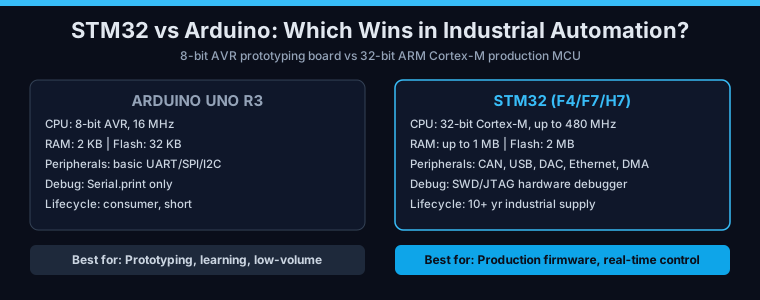
Table of Contents
- 1. Why This Comparison Matters in 2026
- 2. Architecture: 8-bit AVR vs 32-bit ARM Cortex-M
- 3. Performance and Memory
- 4. Peripherals and Connectivity
- 5. Development Environment and Debugging
- 6. Cost and Supply Chain for Production
- 7. When to Choose Arduino vs STM32
- 8. FAQ
- 9. Related Reading
- 10. Sources
1. Why the STM32 vs Arduino Choice Matters in 2026
The STM32 vs Arduino debate is one of the most practical decisions in embedded systems development. If you build automation equipment, motion controllers, or IoT hardware, the choice determines your project’s ceiling. Arduino — built around the 8-bit AVR ATmega328P — remains the most accessible platform ever created for microcontrollers. STM32, STMicroelectronics’ 32-bit ARM Cortex-M family, is what professional firmware engineers use in automotive ECUs, industrial drives, PLCs, and medical devices.
In an industrial context the difference is not about “which is better” but “which is right for this stage of the project.” A factory automation prototype on Arduino can be on your bench in an afternoon. The same control loop in production firmware, with CAN bus, hardware timers and a watchdog, almost always ends up on STM32. Understanding where each fits prevents the two classic failures: over-engineering a simple task, and shipping a prototype that was never designed for the shop floor.
2. Architecture: 8-bit AVR vs 32-bit ARM Cortex-M
The fundamental difference between STM32 vs Arduino is the processor core. The Arduino Uno R3 uses the ATmega328P, an 8-bit AVR running at 16 MHz with 2 KB of SRAM and 32 KB of Flash. An STM32 like the F446RE runs a 32-bit ARM Cortex-M4 at 180 MHz with 128 KB of SRAM and 512 KB of Flash — roughly 11 times the clock speed and 64 times the RAM.
32-bit registers mean STM32 handles floating-point mathematics natively on M4/M7 parts with a hardware FPU, executes DSP instructions, and runs complex control algorithms like field-oriented control (FOC) for motors without breaking a sweat. The ATmega328P emulates floating point in software. For a PID loop at a few hundred hertz either works; for high-rate current loops, vibration analysis, or multi-axis interpolation, the ARM core is required.
3. Performance and Memory
CoreMark-style benchmarks put mid-range STM32 parts at 100–200+ versus single digits for AVR. In practice this means an STM32F103 “Blue Pill” board — often cheaper than an Arduino Nano — delivers 72 MHz, 32-bit processing, 20 KB of RAM and 64–128 KB of Flash. When an Arduino sketch hits the 2 KB SRAM limit or the compiler warns about low memory, you are not just out of space; you are out of headroom for the features your industrial product actually needs.
Higher-end STM32H7 parts reach 480 MHz with up to 2 MB of Flash and 1 MB of RAM, and run FreeRTOS comfortably with multiple task stacks, communication buffers, and complex application logic. Arduino’s 8-bit platform can run a simple RTOS but is severely constrained. If your project needs multitasking with precise timing, STM32 is the natural platform.
4. Peripherals and Connectivity
Industrial automation lives and dies by peripherals. The ATmega328P offers one UART, one SPI, one I2C, six 10-bit ADC channels, and three basic timers. A typical STM32F4 offers four UARTs, four SPI interfaces, three I2C buses, a 12-bit ADC with 16 channels, 20-plus PWM channels, DMA, native USB, and a CAN controller.
CAN bus is the big one. Factory floors, motion controllers, and machine builders standardize on CAN and RS-485/Modbus for networking drives and sensors. STM32 has CAN built in; Arduino needs external modules. Native USB on STM32 lets the chip act as a HID device, virtual COM port, or mass-storage device with no external USB chip. DMA moves data between peripherals and memory without CPU intervention — essential for high-speed ADC sampling and communication. You can read more about building industrial serial networks in our RS485 and Modbus RTU guide.
5. Development Environment and Debugging
Arduino’s IDE is the best onboarding tool in embedded. The setup()/loop() structure, thousands of libraries, and one-click upload let a beginner go from zero to a working sensor read in fifteen minutes. STM32’s professional toolchain — STM32CubeIDE with STM32CubeMX graphical pin and clock configuration, HAL and LL drivers — has a steeper learning curve but delivers hardware debugging.
The debugging gap is decisive in production. Arduino’s only debugging tool is Serial.print(), which means guessing, uploading, and iterating. STM32 Nucleo boards include an ST-Link debugger; you set breakpoints, step through code, and inspect registers live over SWD. Bugs that take hours to find with serial print take minutes with a hardware debugger. For firmware that must run unattended on a production line, that is not a luxury.
6. Cost and Supply Chain for Production
At board level, Arduino Uno ($5–25) and STM32 Nucleo ($15–25) are comparable investments for a maker. The economics flip at production. An ATmega328P costs roughly $2 in quantity; a mid-range STM32 costs $0.50–$15 depending on series. More importantly, STM32 offers industrial temperature grades (-40 to +85 C), long-term availability guarantees often exceeding 10 years, and broad authorized distributor support — attributes Arduino boards do not promise.
For a product your factory or customer will rely on for years, supply-chain certainty matters more than board price. STM32’s pin-compatible families let you scale from a small F0 to a powerful H7 without a PCB redesign. That is why most industrial products migrate from Arduino prototypes to STM32 as the design matures.
7. When to Choose Arduino vs STM32
Choose Arduino when: you are learning, validating a concept, building internal one-off tools, or the whole project fits in 32 KB of Flash and 2 KB of RAM. For simple sensor reading, relay control, and low-volume bench equipment, Arduino’s ecosystem saves enormous time.
Choose STM32 when: you need real-time performance, CAN or USB, high-resolution ADC sampling, ultra-low-power operation, an RTOS, hardware debugging, MISRA C compliance, or long-term production supply. For motor drives, PLC-style controllers, IIoT sensor nodes, and any firmware destined to ship in volume, STM32 is the professional standard. If motion control is your focus, also see our stepper vs servo motor selection guide and PID motor control guide.
The good news is you do not have to choose forever. STM32 boards can be programmed with the Arduino framework via STM32duino, giving roughly 70–80 percent library compatibility while running on much more powerful hardware. Many teams prototype in Arduino, then move the same logic to STM32 with HAL drivers when the design is ready to industrialize. And when your next product needs built-in wireless rather than deterministic real-time control, compare the ESP32 vs ESP8266 before deciding.
Frequently Asked Questions
Is STM32 better than Arduino?
“Better” depends on the job. STM32 is decisively more powerful — faster CPU, more memory, richer peripherals, hardware debugging, and production supply — while Arduino is easier to learn and faster to prototype. For industrial automation products, STM32 is the better platform; for beginners and one-off projects, Arduino is the better tool.
Can I use Arduino code on STM32?
Yes. The official STM32duino core lets you program STM32 boards with the Arduino IDE and most standard libraries. Libraries that touch AVR-specific registers may need changes, but Wire, SPI, Serial and most sensor libraries work with minimal modification.
Is STM32 hard to learn?
STM32 has a steeper learning curve than Arduino, mainly around STM32CubeMX configuration of clocks, DMA, and alternate functions. Most engineers recommend starting with Arduino for 2–3 months, then transitioning to STM32 with STM32CubeIDE — the skills transfer directly to professional embedded work.
Which STM32 should a beginner buy?
The STM32F103 “Blue Pill” is the cheapest entry point and a popular choice among hobbyists in India. For a better experience with an on-board ST-Link debugger, buy a Nucleo-F446RE or a Black Pill (STM32F411).
Can STM32 replace Arduino in all projects?
Electrically and software-wise, STM32 can do everything Arduino can, and far more. The only reason not to switch is when the simplicity and library ecosystem of Arduino save more time than the project demands performance — which is common in education and simple automation.
Related Reading
- PID Motor Control with Arduino and STM32: Closed-Loop Control Guide
- RS485 and Modbus RTU Communication for Industrial Automation
- Stepper vs Servo Motors for CNC: Selection Guide
- ESP32 vs ESP8266: Which IoT Board Should You Choose?
Sources
- Arduino Official Website
- STMicroelectronics STM32 32-bit Arm Cortex MCUs
- STM32 vs Arduino: Industrial and Production Comparison — Moz Electronics
- Arduino vs STM32: Complete Comparison Guide 2026 — Piest Systems
- Arduino vs STM32: Which Microcontroller Platform Wins? — Zbotic
Disclosure: This post contains affiliate links. As an Amazon Associate and partner of electronics distributors, justlast.in may earn a commission on qualifying purchases at no extra cost to you.